Isometric Chest Squeeze
beginner strength exercise · body weight · targets pectorals
- Body part
- chest
- Primary target
- pectorals
- Equipment
- body weight
- Difficulty
- beginner
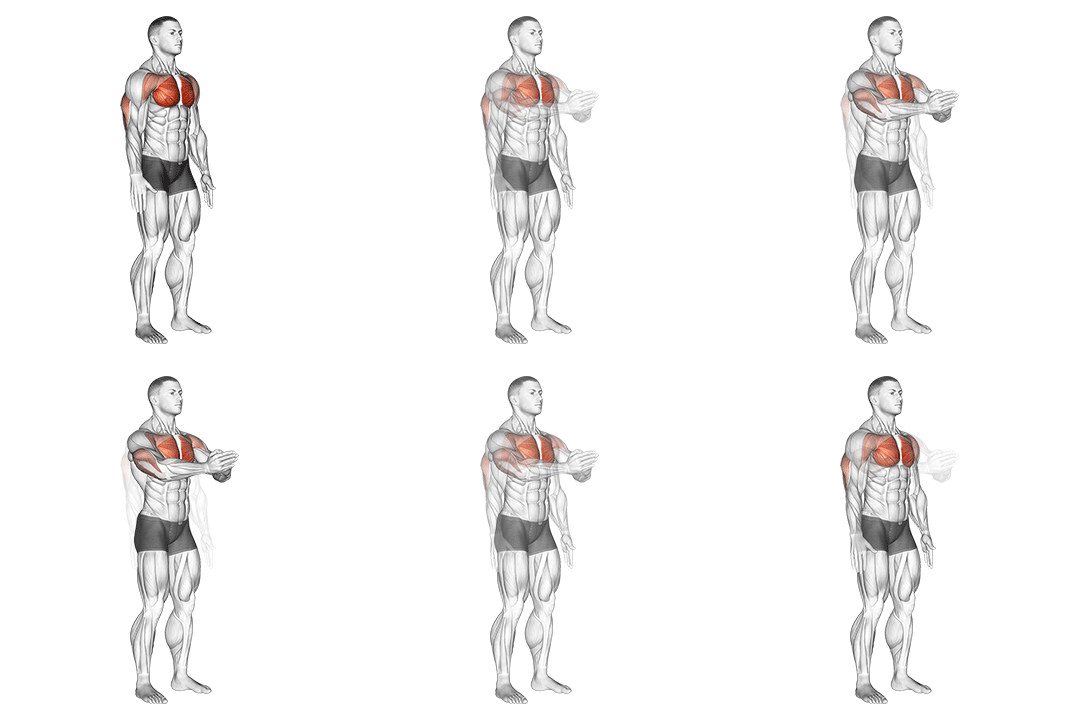
The isometric chest squeeze is a static contraction exercise where you stand with arms extended in front of you, palms facing each other, and squeeze the chest muscles together as hard as possible while keeping the arms straight. The movement isn't really a movement at all — there's no joint range, no concentric or eccentric phase. The work is purely in the contraction itself: voluntarily generating maximum tension in the pectoral muscles for a sustained hold. This exercise sits in an unusual niche in bodyweight training. As a strength builder, it's outclassed by every push-up variation in existence — push-ups load the muscles through their full range with significant resistance, while isometric squeezes only stimulate strength at one specific joint angle. As a hypertrophy driver, it produces minimal muscle growth compared to ranged exercises. So why does it earn a place in some programs? Two reasons: as a learning exercise for trainees who struggle to engage their chest during push-ups, and as a low-equipment finisher when push-up volume is exhausted but you want additional chest stimulus. For most trainees, the isometric chest squeeze is an optional accessory, not a primary exercise. Where it shines is in the mind-muscle connection it builds. Many beginners do push-ups with their arms and shoulders dominating the work, never feeling the chest engage. A few weeks of daily isometric squeezes — done with full attention on contracting the pectoralis — teaches the body what active chest engagement feels like. Once that connection exists, push-ups become more productive, presses feel more natural, and chest training in general improves. The exercise is a tool for learning, more than a tool for building.
Why train the Isometric Chest Squeeze?
- Builds the mind-muscle connection in the pectoralis for trainees who struggle to engage the chest during dynamic exercises.
- Provides a no-equipment finisher option when push-up volume is already exhausted.
- Useful as accessory work during deload weeks or recovery from upper-body injuries.
- Can be performed anywhere — desk, hotel room, airplane — without any equipment or floor space.
- Teaches isometric strength at a specific joint angle, which transfers (slightly) to other pressing work.
- Works as a brief warm-up to prime the chest before pressing or pulling sessions.
How to do the Isometric Chest Squeeze: step by step
- 1Stand with your feet shoulder-width apart and your knees slightly bent.
- 2Extend your arms straight out in front of you, parallel to the ground, with your palms facing each other.
- 3Squeeze your chest muscles together as hard as you can, while keeping your arms straight.
- 4Hold this position for a few seconds, focusing on contracting your chest muscles.
- 5Release the squeeze and relax your chest muscles.
- 6Repeat for the desired number of repetitions.
Muscles worked
Primary
pectorals
Secondary
triceps, shoulders
Common mistakes to avoid
Not actually contracting the chest
The whole exercise is the contraction. If you're just holding the arms out in front without consciously squeezing the chest muscles together, the rep does nothing useful. Visualize bringing the hands together using only the chest, even though they don't actually move. The deliberate contraction is what creates the stimulus.
Letting the shoulders shrug toward the ears
When you contract hard, the trapezius wants to lift the shoulders toward the ears. This shifts loading to the upper traps and away from the chest. Pack the shoulders down and away from the ears throughout the squeeze.
Bending the elbows during the contraction
If the elbows bend, the contraction transfers to the biceps and shoulders. Keep the arms fully straight and locked out throughout. The contraction is in the chest, not in the arm flexors.
Holding too short
Brief 2-second contractions don't build meaningful strength or mind-muscle connection. The hold should be at least 5-10 seconds, ideally up to 20 seconds. Sustained tension is what creates the training stimulus.
Holding the breath during the contraction
Many trainees hold their breath through isometric exercises. Breath-holding spikes blood pressure, which is more relevant in heavy lifting but still avoidable. Breathe slowly and deeply through the squeeze — exhale slightly into the hardest portion.
Easier and harder variations
Easier
Reduce contraction intensity to 50-60% effort, especially if you're new to isometric work or have shoulder issues. The lighter contraction still builds the mind-muscle connection without overloading the joints. Or perform with arms slightly bent rather than fully extended to reduce shoulder demand.
Harder
Progress to longer holds (20-30 seconds at maximum effort) for serious isometric strength training. Or transition to wall press isometrics where the resistance comes from pushing against an immovable wall. For real loaded work, use a resistance band looped around the back to add resistance to the squeeze.
Alternative exercises
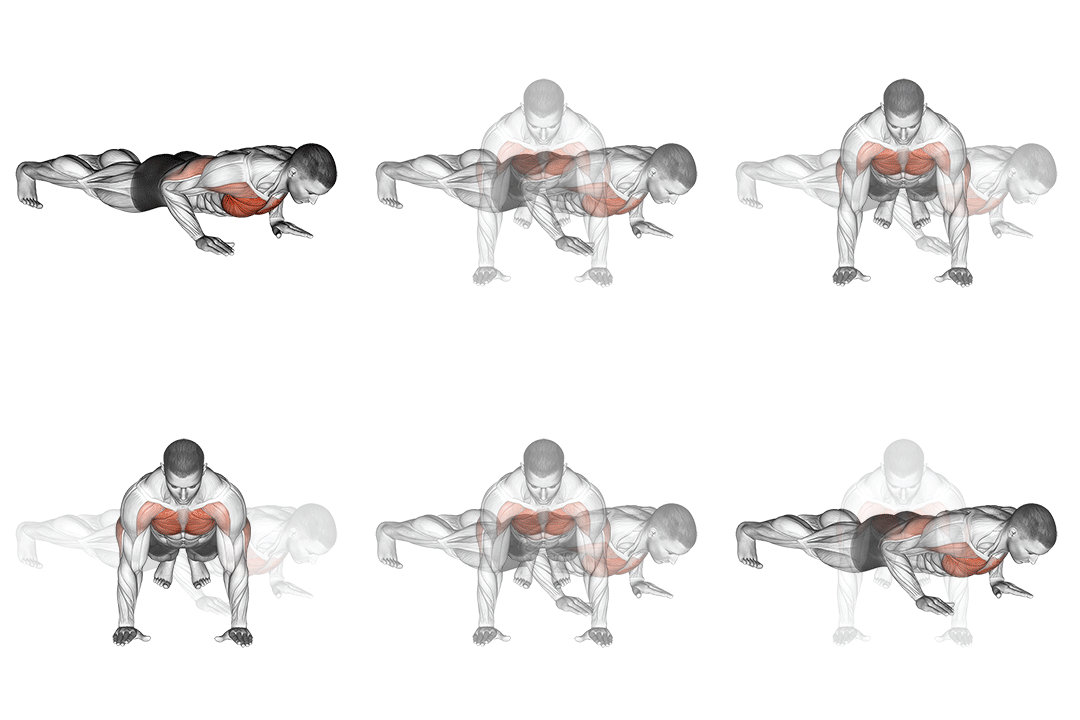
Push-up
Loads the chest through its full range with bodyweight resistance. The most effective bodyweight chest builder. Use this as primary chest work; isometric squeezes as accessory.
Wall press isometric
Pressing against an immovable wall in a push-up position. Provides resistance the unassisted squeeze can't match. Good upgrade for trainees who've outgrown the basic squeeze.
Dynamic chest stretch
Different mechanism — addresses chest mobility rather than chest strength. Pair with the isometric squeeze for compound chest training (mobility + activation).
How to program the Isometric Chest Squeeze into your training
The isometric chest squeeze fits as accessory or learning work, not as a primary chest exercise. Its position in any program depends on the goal. As a learning drill: 3 sets of 10-second holds with 30 seconds rest, performed daily for 2-4 weeks. The goal is mind-muscle connection development. Combined with chest visualization during push-ups, this often unlocks chest engagement for trainees who couldn't feel it before. As a finisher: 2-3 sets of 15-20 second holds at the end of an upper-body session, after primary push-up volume. The post-fatigue chest is more receptive to isometric stimulus, and the additional volume accumulates without the joint stress of more push-ups. As a brief warm-up: 1-2 sets of 5-10 second holds before pressing work to prime the chest neurologically. As travel or deload work: 3-4 sets of 15-20 seconds, 2-3 times per week, when push-ups aren't accessible. The exercise maintains chest stimulus without equipment. Frequency: daily is fine when used for mind-muscle connection development. As a finisher, 2-3 times per week is appropriate, matching push-up training frequency. Don't use this as a replacement for push-ups when push-ups are available. Real pressing work builds far more strength and muscle than isometric squeezes alone.
Recovery and frequency
The isometric chest squeeze has minimal recovery cost. The load is internal (your own contraction) rather than external, and there's no joint range or impact. Daily training is tolerated by most people without issue. Because the load is so dependent on voluntary effort, soreness is rare unless you sustain very long holds at maximum effort. The most common complaint isn't soreness but a sense of having wasted training time when results are subtle. The exercise's main payoff is mind-muscle connection development, which shows up in better push-up performance rather than as visible muscle change. No special recovery protocols apply beyond sleep, hydration, and reasonable nutrition. The exercise's place in a program is as supplementary work; treat it as such and recovery is rarely a concern.
Frequently asked questions
How long should I hold the isometric chest squeeze?
10-20 seconds per hold, 2-3 sets. Beginners can start with 5-10 seconds and build up. Holds shorter than 5 seconds don't drive meaningful adaptation; longer than 30 seconds isn't necessary.
How often should I do this exercise?
Daily is fine when developing mind-muscle connection. As a finisher or accessory, 2-3 times per week alongside push-up training. Recovery cost is minimal so frequency rarely becomes a problem.
Will this build chest muscle?
Honestly, very little. Isometric work builds strength at specific joint angles but produces minimal hypertrophy compared to ranged exercises. For chest building, push-ups and progressive variations are far more effective.
Is this useful for absolute beginners?
Sometimes — as a mind-muscle connection drill before progressing to push-ups. But for most beginners, knee push-ups or elevated push-ups are better starting points because they teach the full pressing pattern with appropriate resistance.
Should I replace push-ups with this exercise?
No, not unless you have an injury that prevents push-up training. Push-ups load the chest through its full range with bodyweight resistance — far more effective for building strength and muscle. The isometric squeeze is supplementary work, not a replacement.
Why don't I feel anything during the exercise?
Two likely causes. First, you're not contracting hard enough — the squeeze should be 70-90% effort, not casual holding. Second, you don't yet have the mind-muscle connection — this takes 2-4 weeks of deliberate daily practice. Be patient and visualize the chest contracting throughout the hold.
Useful tools for this exercise
Build a workout with the Isometric Chest Squeeze
Puna gives you guided bodyweight workouts you can do anywhere — no equipment, no gym, just structured progressions that build real strength.