Front Plank With Twist
intermediate strength exercise · body weight · targets abs
- Body part
- waist
- Primary target
- abs
- Equipment
- body weight
- Difficulty
- intermediate
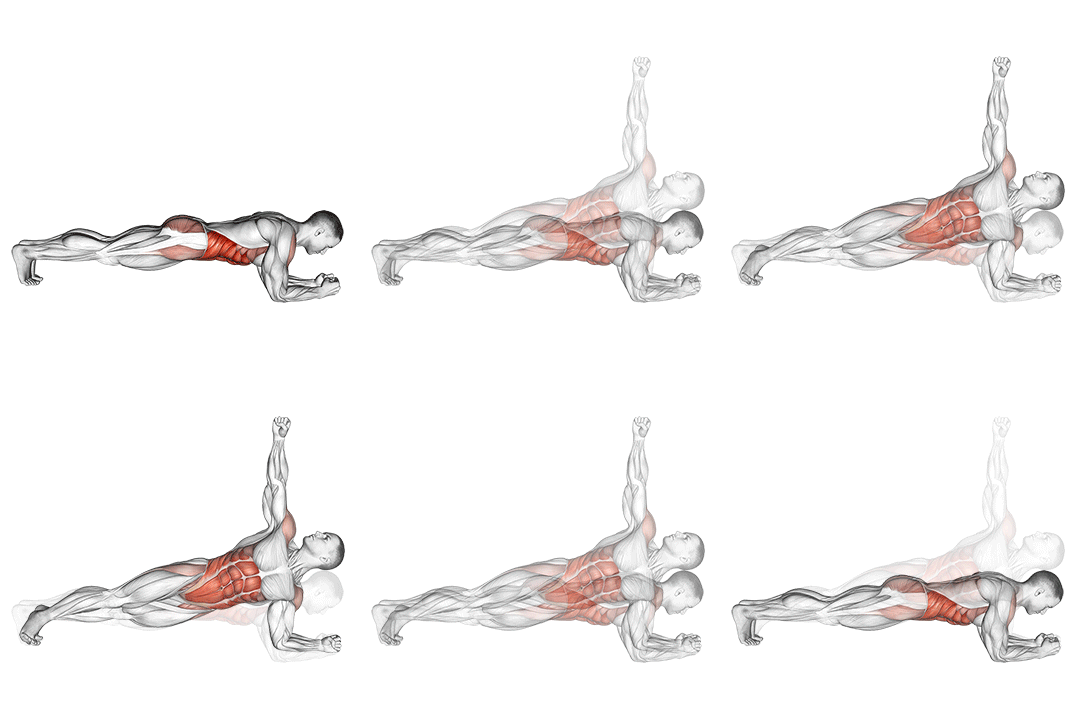
The front plank with twist takes the standard front plank — a static hold — and adds a slow rotational element by dipping the hips to one side and then the other. The plank position trains anti-extension (resisting the lower back arching), and the twist adds rotation work for the obliques. The combination demands more than a basic plank without the joint stress of dynamic core movements. The value of the variation comes from how it challenges the obliques in their actual stabilizing function. Most oblique exercises (Russian twists, side bends) load the obliques as prime movers — they create rotation. The plank with twist trains them differently: the obliques have to control the rotation, not generate it. That control function is what carries over most directly to sport, lifting, and daily movement. It's also a useful evolution for trainees who have outgrown the basic plank. Once a 60-second front plank becomes manageable, adding the twist gives you another 4-8 weeks of meaningful progression before you need to find a harder static variation. The exercise scales smoothly: shallow twists first, deeper twists as control improves.
Why train the Front Plank With Twist?
- Trains the obliques as stabilizers (controlling rotation) rather than prime movers (creating rotation).
- Adds dynamic challenge to the static plank without losing the anti-extension training.
- Provides progression for trainees who have outgrown 60-second basic planks.
- Reveals oblique asymmetries — one side often controls rotation better than the other.
- Requires no equipment, can be performed in any space large enough for a plank.
- Pairs well with anti-rotation work (Pallof press, bird dog) for complete oblique training.
How to do the Front Plank With Twist: step by step
- 1Start in a high plank position with your hands directly under your shoulders and your body in a straight line from head to toe.
- 2Engage your core and glutes to maintain a stable position.
- 3Rotate your torso to the right, lifting your right arm and extending it towards the ceiling.
- 4Keep your hips and legs stable as you twist.
- 5Hold for a moment, then return to the starting position.
- 6Repeat the twist on the left side.
- 7Continue alternating sides for the desired number of repetitions.
Muscles worked
Primary
abs
Secondary
obliques, shoulders
Common mistakes to avoid
Letting the hips touch the floor at the bottom of the twist
The hip should dip toward the floor but not touch — stop an inch or two above. Once the hip touches, the tension drops and the obliques stop working. Maintain control throughout the full range.
Twisting too fast for the obliques to control
Whipping the hips side to side uses momentum and reduces oblique work. Take 2-3 seconds per twist with a pause at each side — control is the entire point of the exercise.
Letting the shoulders drift forward
Some people lean their shoulders past their elbows during the twist, which shifts load away from the core and into the front delts. Keep the shoulders directly over the elbows throughout the movement.
Holding the breath through the rotation
Bracing tightly often means stopping breathing. Breathe steadily through the twist — exhale as the hip dips, inhale on the return. Continuous airflow lets the core work harder.
Choosing this variation before mastering the basic plank
If you can't yet hold a 60-second strict plank, adding the twist trains nothing useful. Build the basic plank first; add the twist when the static hold feels easy.
Easier and harder variations
Easier
Reduce the depth of the twist — small dips to start, building to deeper rotations over weeks. Or perform from a kneeling plank position to reduce the load on the upper body.
Harder
Add a hold at the bottom of each twist (3-5 seconds in the dipped position). Or progress to side plank with hip dip — same rotation in a more demanding starting position.
Alternative exercises
Side plank
Static lateral hold that trains the obliques in a different position. Useful complement to the dynamic plank with twist.
Plank with hip dip (no twist)
Same plank position, simpler hip movement (just dip down without rotation). Easier regression that still trains some oblique work.
Pallof press
Standing anti-rotation exercise using a band or cable. Different position, similar oblique training principle.
How to program the Front Plank With Twist into your training
Front plank with twist works as either core finisher or part of a structured core circuit. Pair with anti-extension and anti-rotation exercises for complete core development. Sets and reps: 3 sets of 8-12 twists per side with 30-60 seconds rest. Time-based alternative: 3 sets of 30-45 seconds of continuous twisting at slow tempo. In a complete core circuit: 3 rounds of 10 dead bugs per side, 30-second standard plank, 8 plank twists per side, 12 reverse crunches. Done 2-3 times per week. As a finisher: 2 sets of 10 plank twists per side at the end of an upper-body or lower-body session. Adds useful core volume without lengthening the workout significantly. For athletes building rotational stability, pair plank twists with Pallof presses and bird dogs in the same session — three different anti-rotation exercises that each load the obliques in slightly different positions. Do not program plank twists on the same day as heavy Russian twists or other rotational core work — the cumulative oblique demand can slow recovery.
Recovery and frequency
Plank twists at moderate volume have low recovery cost — 48 hours between dedicated sessions is plenty. The shoulders take some cumulative load from the plank position; if shoulders feel achy after sessions, reduce volume or alternate with non-plank core work. Oblique soreness in the first 1-2 weeks of training is normal and fades quickly. Lower back fatigue during or after the exercise usually points to form errors — typically hips dropping in the standard plank position, which loads the lumbar spine. Address the form issue before continuing.
Frequently asked questions
How many sets and reps of front plank with twist should I do?
3 sets of 8-12 twists per side with 30-60 seconds rest. Or 3 sets of 30-45 seconds of continuous slow twisting.
How often should I train the front plank with twist?
2-3 times per week as part of a structured core program. The obliques recover within 48 hours of moderate work.
Front plank with twist vs Russian twist: which is better?
Different tools. Plank twists train the obliques as stabilizers (controlling rotation). Russian twists train them as prime movers (creating rotation). For complete oblique development, both have value.
Should I count one rep as both sides or each side separately?
Each side separately. Counting per side gives clearer progression tracking and prevents accidentally favoring the easier side.
Why is one side so much harder than the other?
Almost everyone has trunk asymmetry. The dominant-arm side usually feels easier because the body is more practiced at stabilizing for that arm. The asymmetry typically narrows within 6-12 weeks of equal-rep practice.
Can I do this exercise if I have shoulder issues?
Depends on the issue. The plank position loads the shoulders isometrically. If you can hold a basic plank without shoulder pain, the twist version is usually fine. If basic planks aggravate the shoulder, see a physical therapist before adding the twist.
Useful tools for this exercise
Build a workout with the Front Plank With Twist
Puna gives you guided bodyweight workouts you can do anywhere — no equipment, no gym, just structured progressions that build real strength.