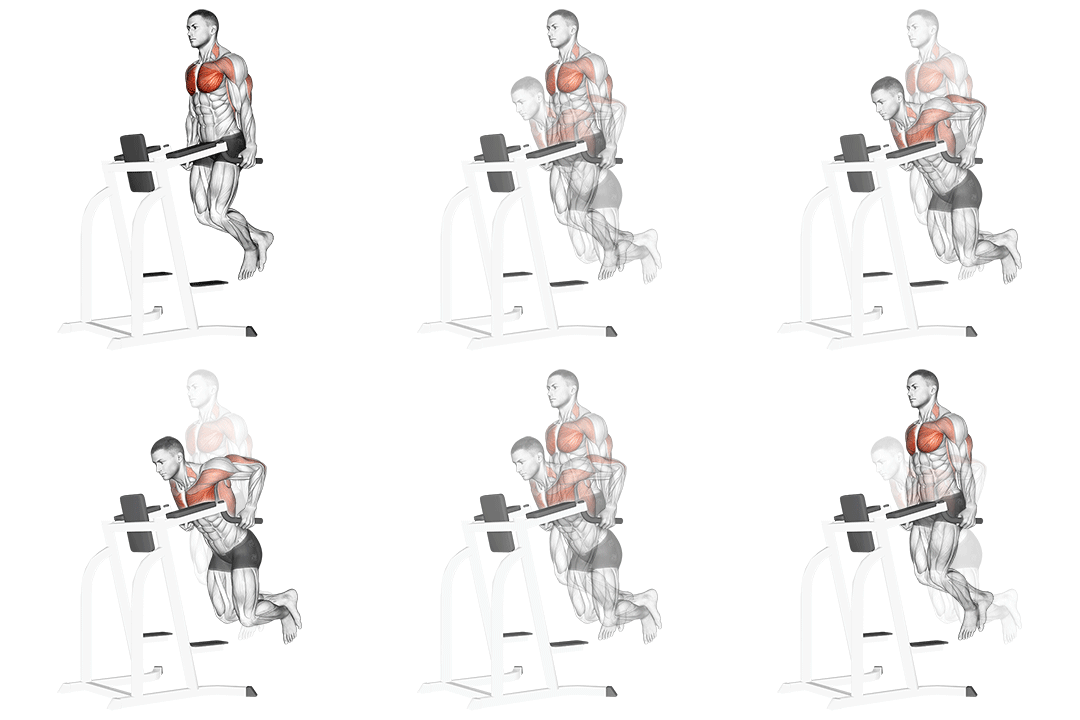
Full Planche Push-up
advanced strength exercise · body weight · targets pectorals
- Body part
- chest
- Primary target
- pectorals
- Equipment
- body weight
- Difficulty
- advanced
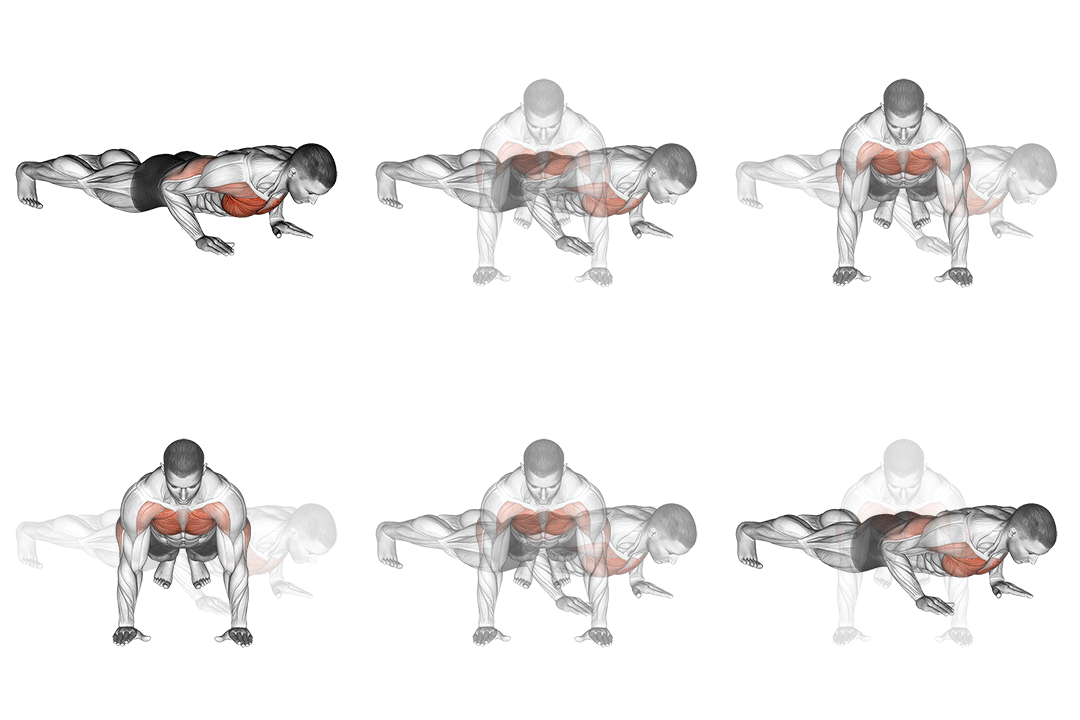
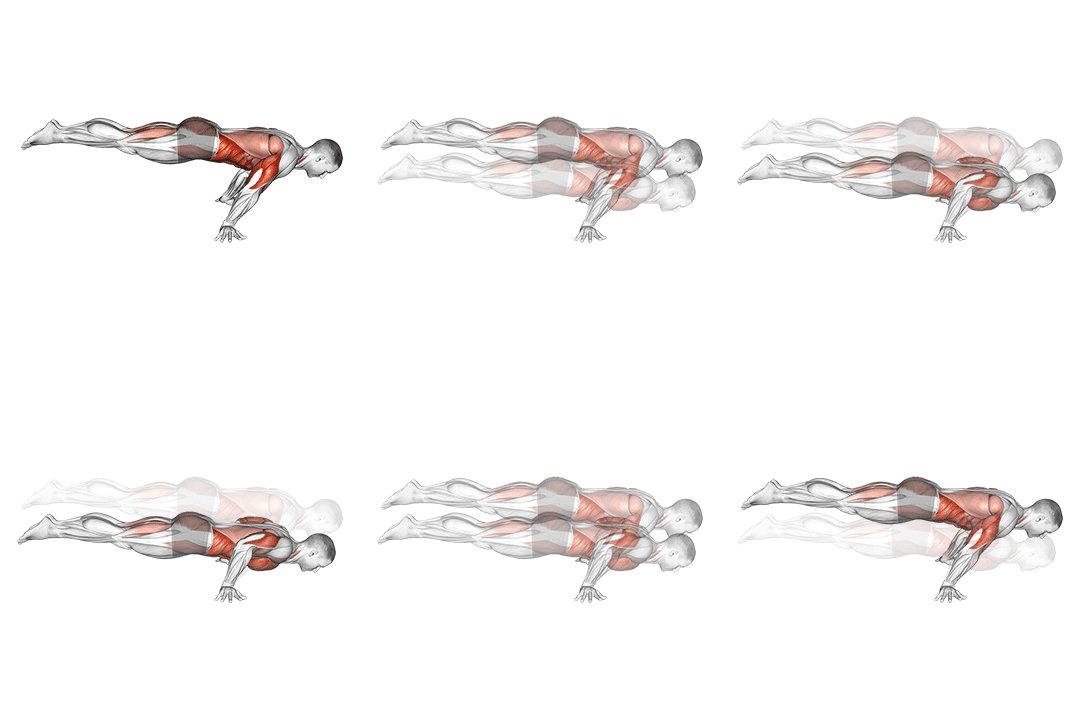
The full planche push-up is the apex of bodyweight pressing — performed in the planche position (body parallel to the floor, feet off the ground, supported entirely on the hands), you press up and down through the same range as a standard push-up but with all body weight loaded on the shoulders and chest in an extreme leverage position. Reaching even a single strict full planche push-up typically takes 2-5 years of dedicated calisthenics training, making it one of the longest-term goals in bodyweight strength training. The difficulty comes from the leverage. In a normal push-up, the feet bear roughly 35% of body weight. In a planche position, the hands bear 100%. Combined with the arms supporting the body in a horizontal-floating position, the shoulders, chest, and core have to produce force at a leverage disadvantage that no other bodyweight exercise creates. Even strong bench pressers who can press 1.5x their body weight often can't hold a single tuck planche, much less perform a full planche push-up. The progression involves years of patient work: planche leans, tuck planche holds, advanced tuck planche, straddle planche, full planche hold, and finally planche push-ups. Most calisthenics athletes never achieve a full planche push-up — and that's fine. The progression itself produces extraordinary upper-body strength.
Why train the Full Planche Push-up?
- Builds the highest level of bodyweight pressing strength achievable.
- Develops shoulder stability, chest strength, and core control to elite levels.
- Provides multi-year progression goals that drive consistent training motivation.
- Carries over to almost every pressing and gymnastics movement.
- Once achieved, makes most other bodyweight pressing feel trivial.
- Requires no equipment beyond a clear floor space.
How to do the Full Planche Push-up: step by step
- 1Start in a push-up position with your hands placed slightly wider than shoulder-width apart.
- 2Engage your core and lower your body down towards the ground, keeping your elbows close to your sides.
- 3As you lower yourself, lean your body forward and lift your feet off the ground, balancing on your hands.
- 4Continue to lower your body until your chest is just above the ground.
- 5Push through your hands and extend your arms to lift your body back up to the starting position.
- 6Maintain a straight line from your head to your heels throughout the movement.
- 7Repeat for the desired number of repetitions.
Muscles worked
Primary
pectorals
Secondary
shoulders, triceps, core
Common mistakes to avoid
Attempting full planche push-ups without prerequisite work
Most failed planche push-up attempts come from people who hadn't built tuck planche, advanced tuck planche, and full planche holds first. The progression is years long — there are no shortcuts.
Letting the hips sag
The body must stay parallel to the floor throughout the rep. Sagging hips defeat the entire point — if the feet touch the floor, you're doing a standard push-up, not a planche push-up.
Bending the elbows asymmetrically
Both elbows must bend evenly. If one bends faster, the body will rotate — which usually means falling. Symmetry of pressing is non-negotiable in this exercise.
Programming planche push-ups before achieving full planche holds
Don't attempt planche push-ups until you can hold a full planche position for 5+ seconds. Without that base, every attempt is just falling on your face.
Skipping wrist preparation
The hands take all body weight in a position the wrists weren't designed for. Daily wrist mobility (1-2 minutes minimum) is non-negotiable for anyone training planche progressions.
Easier and harder variations
Easier
Tuck planche push-ups (knees pulled to chest in the planche position). Advanced tuck planche push-ups (knees lower, partial body extension). Straddle planche push-ups (legs spread wide). All are stepping stones to the full planche version.
Harder
Add weight (a small vest). Slow tempo (5+ seconds per phase). Or progress to one-arm planche work (ultra-elite, achieved by very few). Most trainees never need to go beyond full planche push-ups.
Alternative exercises
Tuck planche hold
Static version of the planche position with knees pulled to chest. Essential prerequisite work.
Planche lean
Standing high plank with shoulders shifted forward of the wrists. The most basic planche progression.
Pseudo-planche push-up
Push-up with hands shifted toward the hips and fingers pointed back. Builds toward planche-style loading.
How to program the Full Planche Push-up into your training
Full planche push-up training is for advanced calisthenics athletes only. Programming requires patience and respect for the years-long progression. For trainees with established planche holds: 3-4 sets of 1-3 reps with 3-4 minutes rest, twice per week. Total weekly volume of 6-15 reps. In a planche-focused session: tuck planche holds (4 sets of 15-30 seconds), straddle planche holds (3 sets of 10-20 seconds), planche push-up attempts (3-4 sets of 1-3 reps), supplemental pressing (push-ups, dips, handstand work). For athletes building toward planche push-ups, run 8-12 week progression blocks: tuck planche progression Block 1, advanced tuck Block 2, straddle planche Block 3, full planche Block 4. Each block typically runs 12-16 weeks with progressive demands. Total weekly planche-related training shouldn't exceed 15-20 minutes of focused work. The recovery cost limits productive volume.
Recovery and frequency
Planche push-ups are extreme on the wrists, shoulders, and central nervous system. 72-96 hours between sessions is the right cadence. Watch for any sharp wrist or shoulder pain — these are the limiting injury sites in planche training. Daily wrist mobility, weekly foam rolling of the chest, lats, and shoulders, and 8+ hours of sleep are all essential during heavy planche training phases.
Frequently asked questions
How many sets and reps of full planche push-ups should I do?
3-4 sets of 1-3 reps with 3-4 minutes rest. Total weekly volume of 6-15 reps for advanced trainees.
How often should I train the full planche push-up?
1-2 times per week with 72-96 hours of recovery between sessions.
How long does it take to learn a full planche push-up?
From scratch, plan on 2-5 years of dedicated calisthenics training. From a base of advanced calisthenics work (tuck planche holds), expect 12-24 months.
Are planche push-ups bad for the wrists?
If volume ramps too aggressively or wrist mobility is neglected, yes — wrist tendinopathy and chronic injuries are common in rushed trainees. With patient progression and consistent wrist preparation, no.
Will planche push-ups give me a full planche?
They're part of the path. The full planche is a static hold; planche push-ups are the dynamic version. Both progressions are typically trained together for complete planche development.
Should I train planche push-ups for general fitness?
No — they're vastly overkill for general fitness goals. Standard push-ups, dips, and weighted variations cover all general fitness needs. Reserve planche push-ups for athletes specifically pursuing advanced calisthenics goals.
Useful tools for this exercise
Build a workout with the Full Planche Push-up
Puna gives you guided bodyweight workouts you can do anywhere — no equipment, no gym, just structured progressions that build real strength.