Suspended Split Squat
advanced strength exercise · body weight · targets quads
- Body part
- upper legs
- Primary target
- quads
- Equipment
- body weight
- Difficulty
- advanced
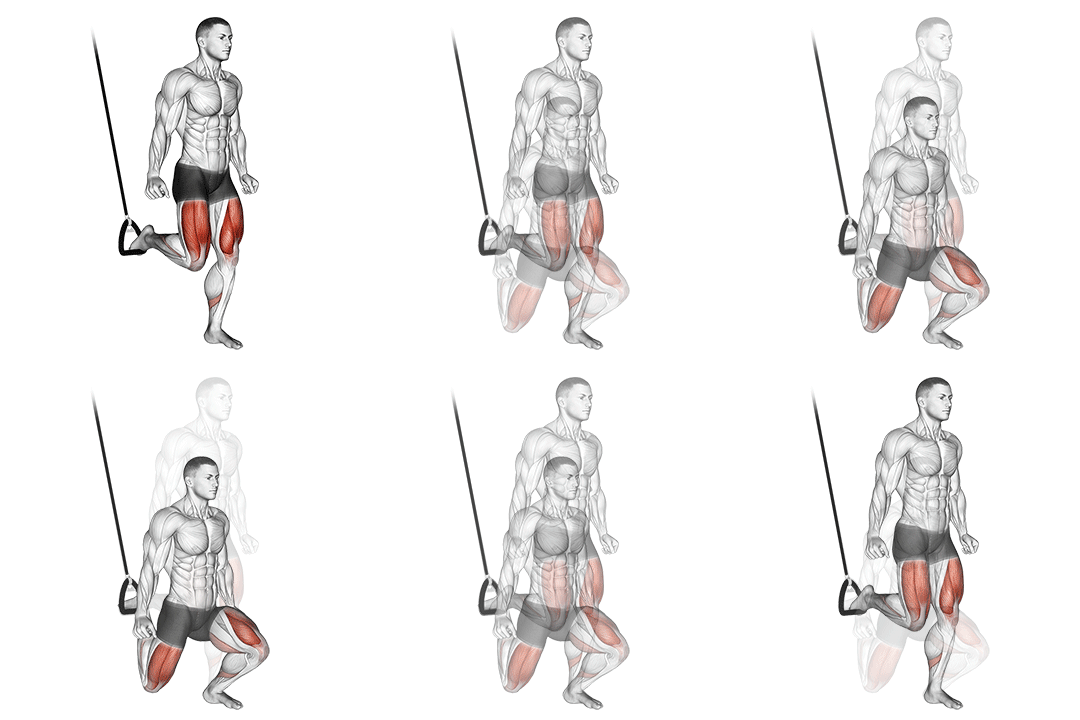
The suspended split squat is performed with the back foot in a TRX strap or suspension trainer instead of resting on a bench. The hanging back foot adds significant instability to the standard Bulgarian split squat — the foot wants to swing in any direction, forcing the front leg to do even more work and the core to fight unwanted rotation throughout the rep. This is one of the most demanding unilateral leg exercises in calisthenics. The combination of full body weight on the front leg, the unstable back foot, and the deep range of motion creates a training stimulus that builds genuine single-leg strength faster than almost any bodyweight alternative. Most trainees who can do 10+ Bulgarian split squats per leg on a fixed bench can manage only 5-8 suspended split squats per leg in their first attempts. It's particularly useful for athletes who need single-leg strength expressed in dynamic conditions — basketball players, soccer players, climbers, and anyone whose sport involves rapid changes of single-leg loading. The unstable back foot mimics real-world single-leg situations better than fixed-bench versions.
Why train the Suspended Split Squat?
- Higher instability demand than fixed-bench Bulgarian split squats.
- Builds genuine single-leg strength under dynamic conditions.
- Trains anti-rotation core work alongside leg strength.
- Reveals strength asymmetries between sides.
- Carries over to athletic sports requiring single-leg dynamic strength.
- Scales by adjusting strap height or adding load.
How to do the Suspended Split Squat: step by step
- 1Stand facing away from a suspension trainer with your feet shoulder-width apart.
- 2Extend one leg forward and place the top of your foot in the foot cradle of the suspension trainer.
- 3Bend your standing leg and lower your body down into a lunge position, keeping your chest up and your knee in line with your toes.
- 4Push through your heel to return to the starting position.
- 5Repeat for the desired number of repetitions, then switch legs.
Muscles worked
Primary
quads
Secondary
glutes, hamstrings, calves
Common mistakes to avoid
Letting the back foot swing for momentum
The hanging foot creates instability that the body wants to manage with momentum. Keep the back foot deliberately still throughout the rep — let the front leg do all the work, not the swinging back foot.
Front knee tracking past the toes
Step further forward to keep the front shin closer to vertical. The knee should track over the ankle, not past the toes.
Letting the torso lean forward
The added instability tempts trainees to hunch forward for balance. Keep the chest tall and torso upright throughout — bracing the core helps maintain position.
Setting the strap too low or too high
The back foot should hang at roughly knee height. Too low and the strap is barely involved; too high and the position becomes uncomfortable on the hip flexor.
Choosing this before mastering Bulgarian split squats on bench
Build to 3 sets of 10 strict Bulgarian split squats per leg on a fixed bench before adding the suspended back foot. Without that base, the exercise becomes too unstable to perform productively.
Easier and harder variations
Easier
Standard Bulgarian split squat with back foot on a fixed bench. Or split squat with back foot on the floor.
Harder
Add weight (dumbbells held at the sides). Slow the tempo (5 seconds down, 1-second pause, 1 second up). Or progress to single-leg pistol squats for ultimate unilateral strength.
Alternative exercises
Bulgarian split squat
Same exercise concept with back foot on a fixed bench instead of suspended. Easier and more accessible.
Pistol squat
True single-leg squat with no support. Even more demanding than suspended split squats.
Reverse lunge
Both feet on the floor, stepping back into the position. Easier alternative without the suspended foot demand.
How to program the Suspended Split Squat into your training
Suspended split squats work as a primary unilateral leg exercise for trainees with access to suspension trainers and the prerequisite strength. Sets and reps: 3-4 sets of 6-10 reps per leg with 90-120 seconds rest. Total weekly volume of 30-60 reps per leg drives most adaptations. In a lower body session: 4 sets of 8 squats (bilateral strength), 3 sets of 8 suspended split squats per leg (unilateral), 3 sets of 12 single-leg glute bridges per leg (accessory), 3 sets of 30-second front planks (core). Done twice per week. For athletes building dynamic single-leg strength: alternate weeks between suspended split squats and other unilateral progressions like reverse lunges or pistol squat training. Do not pair with heavy bilateral squats in the same session — the cumulative leg fatigue is excessive.
Recovery and frequency
Suspended split squats are demanding on the front-leg quad, glute, and the hip stabilizers. 48-72 hours between sessions is the right cadence. Leg soreness in the first 1-2 weeks is significant due to the instability. Standard recovery practices apply.
Frequently asked questions
How many sets and reps of suspended split squats should I do?
3-4 sets of 6-10 reps per leg with 90-120 seconds rest.
How often should I train suspended split squats?
1-2 times per week with 48-72 hours between sessions.
Suspended vs standard Bulgarian split squats: which is better?
Different tools. Standard Bulgarian split squats are the entry point with fixed-bench support. Suspended versions add instability that trains stabilizers and dynamic single-leg strength. Use suspended after mastering standard.
Do I need a TRX for suspended split squats?
Any suspension trainer (TRX, rings, or rated straps) works. Don't improvise with non-rated straps — failure under load can cause injury.
Why is one leg so much weaker?
Unilateral strength asymmetry — almost everyone has it. The dominant leg is usually 5-15% stronger. The asymmetry typically narrows within 8-12 weeks of equal-rep practice.
Can I do suspended split squats with knee pain?
Depends on the source. The deep range and instability can aggravate some knee conditions. Get medical clearance if you have known knee issues.
Useful tools for this exercise
Build a workout with the Suspended Split Squat
Puna gives you guided bodyweight workouts you can do anywhere — no equipment, no gym, just structured progressions that build real strength.