Split Squats
beginner strength exercise · body weight · targets quads
- Body part
- upper legs
- Primary target
- quads
- Equipment
- body weight
- Difficulty
- beginner
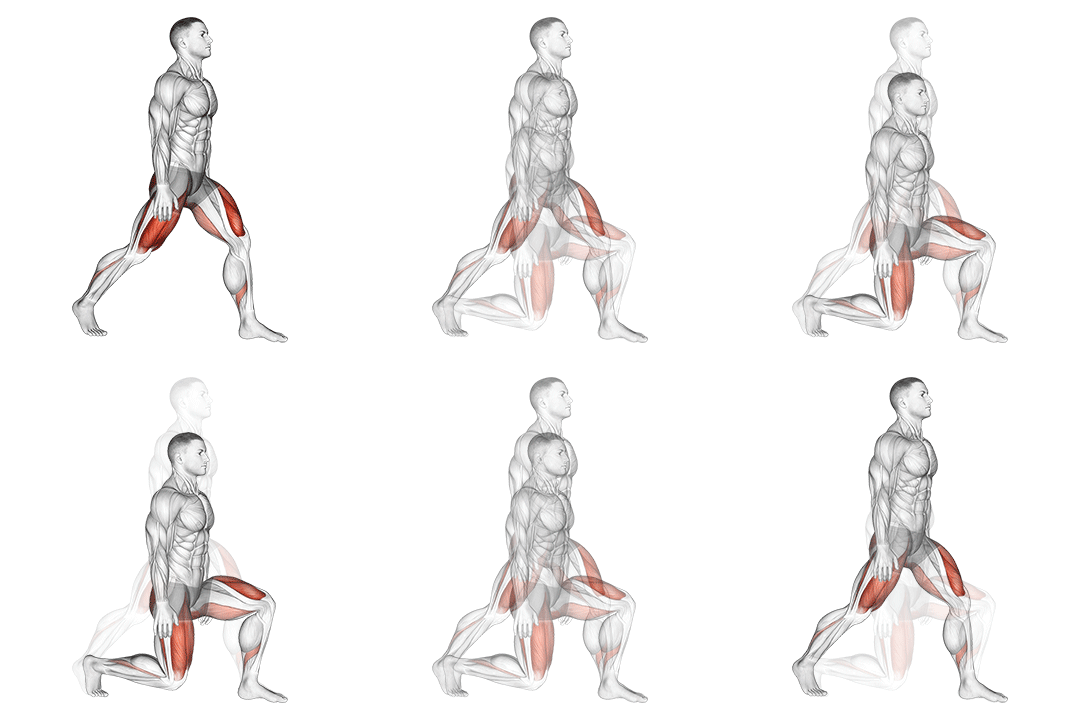
The split squat is the stationary version of a lunge — performed by stepping one foot forward into a long stance and lowering the back knee toward the floor without moving either foot. Unlike walking lunges, you stay in the same position for the entire set, which lets you focus on form, depth, and the strength contraction without the additional balance demand of stepping in and out. This stationary nature is what makes the split squat a useful learning exercise and primary unilateral strength tool. Beginners who struggle with the balance demand of walking lunges can usually do split squats well — both feet stay planted, only the body moves up and down. Advanced trainees can add load (dumbbells, a goblet, or a barbell on the back) and use split squats as one of the most efficient unilateral strength builders in any program. Master the basic split squat first; the variations come naturally once the pattern is solid. Bulgarian split squats (back foot elevated), forward and reverse lunges, walking lunges, and pistol squats all build on the foundation that split squats establish. For trainees building a long-term lower-body strength program, split squats are the right starting point in the unilateral squat family.
Why train the Split Squats?
- Trains each leg independently — exposes and corrects strength asymmetries.
- Loads the front leg through a long range of motion with significant glute and quad work.
- Lower balance demand than walking lunges, making it accessible to beginners.
- Scales smoothly from bodyweight to heavy weighted variations for years of progression.
- Foundation for all advanced unilateral squat variations (Bulgarian, walking lunges, pistols).
- Requires zero equipment and minimal space.
How to do the Split Squats: step by step
- 1Stand with your feet shoulder-width apart.
- 2Take a step forward with one foot and place it about two feet in front of the other foot.
- 3Lower your body by bending your knees and hips, keeping your back straight.
- 4Continue lowering until your front thigh is parallel to the ground, and your back knee is hovering just above the ground.
- 5Pause for a moment, then push through your front heel to return to the starting position.
- 6Repeat for the desired number of repetitions, then switch legs and repeat.
Muscles worked
Primary
quads
Secondary
glutes, hamstrings, calves
Common mistakes to avoid
Letting the front knee drift past the toes
When the front knee moves significantly past the front foot, load shifts forward into the patellar tendon. Set a long stance — long enough that the front shin can stay close to vertical at the bottom of the rep.
Letting the back knee crash into the floor
Slamming the back knee down stresses the joint. Lower the back knee with control until it's an inch or two from the floor, then drive back up.
Letting the torso lean forward
Pitching the chest forward shifts load onto the lower back and reduces glute engagement. Keep the torso upright throughout the rep — chest tall, eyes on the horizon.
Stepping too short
Short steps turn the split squat into a knee-dominant exercise that overloads the front knee. Step long enough that both knees can bend to 90 degrees in the bottom position.
Pushing back to standing using the back leg
The split squat should be driven primarily by the front leg's quad and glute. Press through the heel of the front foot to return to standing — the back leg is mostly for balance, not propulsion.
Easier and harder variations
Easier
Reduce the depth of the squat — only bend the knees to 60-70 degrees instead of 90. Hold onto a sturdy object (chair, wall) for balance assistance. Or take a shorter stance to reduce the range of motion.
Harder
Add weight (dumbbells held at the sides, a goblet at the chest, or a barbell on the back). Progress to Bulgarian split squats (back foot elevated on a bench). Add tempo (3 seconds down, 1-second pause, 1 second up).
Alternative exercises
Bulgarian split squat
Back foot elevated on a bench, dramatically increasing the load on the front leg. Significantly harder progression after standard split squats.
Forward lunge
Step forward into the position instead of holding it stationary. Adds dynamic component and balance demand.
Walking lunge
Continuous forward lunges across a space. Higher cardio and balance demand than split squats.
How to program the Split Squats into your training
Split squats work as the foundational unilateral leg movement for most trainees. They scale well from bodyweight to heavy weighted variations. Sets and reps: 3-4 sets of 8-12 reps per leg with 60-90 seconds rest. Total weekly volume of 50-100 reps per leg drives most adaptations. In a lower body session: 4 sets of 8 squats (bilateral strength), 3 sets of 10 split squats per leg (unilateral), 3 sets of 12 single-leg glute bridges per leg (accessory), 3 sets of 30-second front planks (core). Done twice per week. With added weight, treat split squats as a strength exercise: 3-4 sets of 6-10 reps per leg with longer rest (90-120 seconds). For beginners building unilateral strength: 3 sessions per week of bodyweight split squats (3 sets of 10-12 per leg), progress to weighted versions over 4-8 weeks once 3 sets of 12 strict bodyweight reps feel easy. Do not program heavy split squats on the same day as heavy bilateral squats — both load the same systems and recovery suffers.
Recovery and frequency
Split squats in moderate volume have moderate recovery cost. The unilateral loading usually leaves the glutes and quads notably sore for 1-2 days, especially in the first weeks of training. 48 hours between sessions is generally enough. Knee discomfort during the exercise points to form errors (front knee tracking past toes, torso leaning forward). Address form first; reduce range second. Hip mobility work between sessions speeds recovery.
Frequently asked questions
How many sets and reps of split squats should I do?
3-4 sets of 8-12 reps per leg with 60-90 seconds rest. Total weekly volume of 50-100 reps per leg builds strength and corrects asymmetries.
How often should I train split squats?
2-3 times per week with 48 hours between sessions.
Split squats vs Bulgarian split squats: which is better?
Standard split squats are easier and the entry point. Bulgarian split squats (back foot elevated) are significantly harder and the natural progression. Use standard first; progress to Bulgarian once standard feels easy.
Why is one leg so much weaker in split squats?
Almost everyone has unilateral strength asymmetry. The dominant leg is usually 5-15% stronger. The asymmetry typically narrows within 8-12 weeks of equal-rep practice.
Should I add weight or do more reps?
Once you can do 3 sets of 12 strict bodyweight split squats per leg, add weight. Adding more reps trains endurance more than strength — diminishing returns for size and force production.
Can I do split squats with knee pain?
Depends on the source. Knee discomfort during split squats often points to form issues that are correctable. If pain persists after form correction, see a physical therapist.
Useful tools for this exercise
Build a workout with the Split Squats
Puna gives you guided bodyweight workouts you can do anywhere — no equipment, no gym, just structured progressions that build real strength.