Push-up Inside Leg Kick
intermediate strength exercise · body weight · targets glutes
- Body part
- upper legs
- Primary target
- glutes
- Equipment
- body weight
- Difficulty
- intermediate
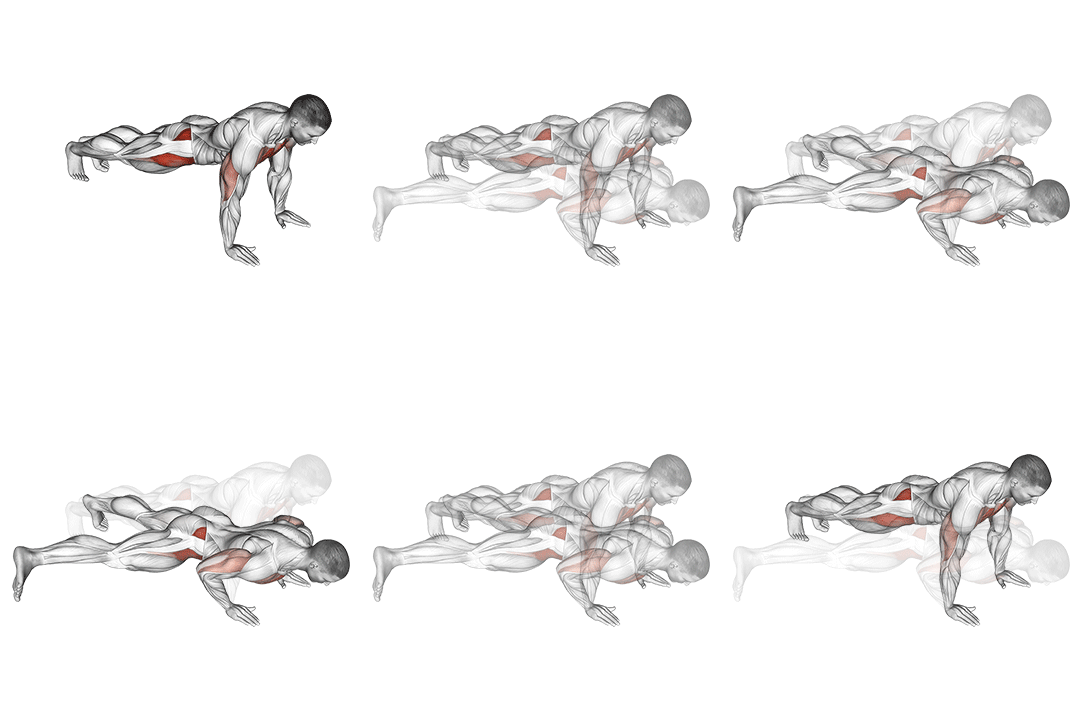
The push-up inside leg kick layers a unilateral leg movement onto every push-up rep, turning a chest exercise into a full-body coordination challenge. You complete a push-up, then on the way up kick one leg out to the side while keeping your hips square. The leg kick demands sharp glute and abductor activation, while the asymmetric base forces the core to fight rotation. It's a useful exercise for athletes — the demand pattern resembles many sport actions where you generate force through an arm while a leg moves independently. Tennis serves, baseball pitches, freestyle swimming, and most striking martial arts all share this same coordination requirement: stable trunk while limbs move asymmetrically. It's also a humbling test of whether your basic push-up form survives an added challenge. Many people who can knock out 30 strict push-ups find themselves struggling with 5 clean reps of this variation — the moment the leg lifts, the hips want to rotate, the chest wants to dip, and the brain has to coordinate three things at once. That's the point. Adding complexity to a familiar movement is often a faster route to athletic performance than just adding load. Don't expect the same rep counts as your standard push-up. The added coordination demand cuts your usable volume by roughly 40-50%, and that's what's driving the adaptation.
Why train the Push-up Inside Leg Kick?
- Adds glute medius and abductor work to a movement that's traditionally upper-body only.
- Trains anti-rotation core strength — the obliques work hard to keep the hips from twisting.
- Builds coordination between independent upper and lower body actions, useful for athletic transfer.
- Spends more time at the top of the push-up than a standard rep, which can improve lockout strength.
- Reveals balance asymmetries between left and right sides that standard push-ups hide.
- Adds variety to home programming when standard push-ups have become routine.
How to do the Push-up Inside Leg Kick: step by step
- 1Start in a push-up position with your hands slightly wider than shoulder-width apart and your feet together.
- 2Lower your body towards the ground by bending your elbows, keeping your back straight and your core engaged.
- 3As you push back up, lift one leg off the ground and kick it out to the side, keeping it straight.
- 4Lower your leg back down and repeat the push-up, then switch to the other leg.
- 5Continue alternating leg kicks with each push-up repetition.
Muscles worked
Primary
glutes
Secondary
quadriceps, hamstrings, calves, core
Common mistakes to avoid
Twisting the hips during the leg kick
If the hip on the kicking-leg side rises, the core has lost the fight. Keep both hip points facing the floor by bracing the abs harder before the kick and lifting the leg from the glute, not from the hip flexor.
Bending the knee of the kicking leg
Letting the knee bend reduces the glute and abductor work that makes this movement valuable. Lock the knee straight before lifting and keep it that way through the full kick.
Cheating the push-up depth to save energy
Adding the leg kick is hard, so the temptation is to do half push-ups. Keep your chest going to within an inch of the ground on every rep — partial range turns this into a leg drill with extra steps.
Kicking too high too fast
Trying to kick the leg up to hip height in the first sessions almost always means a hip rotation compensation. Start with a small kick — 6 to 12 inches off the floor — and increase range as control improves.
Holding the breath through the rep
The added complexity makes people brace and stop breathing. Exhale on the press and the kick, inhale on the way down — keep the breath moving so the core can work through the full range.
Easier and harder variations
Easier
Do the push-up and the leg kick as separate movements: one push-up, then while still in plank kick one leg out, return, kick the other, then drop into the next push-up. This breaks the timing demand.
Harder
Add a hold: kick the leg out and hold for 2-3 seconds before returning. Or progress to a single-leg push-up where one foot stays elevated through the entire push-up.
Alternative exercises
Single-leg push-up
One foot stays lifted through the entire push-up. Same anti-rotation demand as the leg kick variant but with constant leg elevation rather than alternating kicks.
Spiderman push-up
Knee comes to elbow on each rep instead of leg kicking out. Targets the obliques more directly while still demanding hip stability.
Plank fire hydrant
From a high plank, lift one knee out to the side. Trains the same glute medius work without the push-up component — useful as a regression or pre-fatigue drill.
How to program the Push-up Inside Leg Kick into your training
Treat push-up inside leg kick as accessory work, not a primary lift. Insert it after your main pressing exercise when you want to add coordination and unilateral hip work without adding session length. Sets and reps: 3 sets of 6-10 reps per side with 60-90 seconds rest. Going beyond 10 reps per side usually means form has decayed; going below 6 means you might benefit from an easier variation. A useful weekly structure: 2 dedicated upper body sessions, with this exercise as the second push variation. For example: Monday — main bench or floor press for 4 sets of 6-8, then 3 sets of 8 push-up inside leg kicks per side, then row variation; Thursday — repeat with different rep schemes. For athletic populations, this fits well in a circuit format. A 4-station circuit example: 8 push-up inside leg kicks per side, 10 single-arm rows per side, 30 seconds side plank per side, 8 reverse lunges per leg. Three rounds, 60 seconds rest between rounds. Pair it with anti-rotation work like Pallof presses or bird dogs in the same training block — both train the trunk to resist rotation, but from different starting positions. The combination is more comprehensive than either alone.
Recovery and frequency
The unilateral hip work and the additional core demand mean push-up inside leg kicks can leave the obliques and glute medius surprisingly sore in the first 2 weeks. Both fade as the muscles adapt — typically by week 3, the soreness is minimal even with continued training. 48 hours between sessions is sufficient for most people. The chest and triceps don't get hammered the way they would with heavier pressing, but the coordination demand fatigues the central nervous system more than rep count alone suggests. If you feel mentally drained from training rather than just physically tired, that's CNS fatigue and a sign to back off frequency for a week.
Frequently asked questions
How many sets and reps of push-up inside leg kick should I do?
3 sets of 6-10 reps per side with 60-90 seconds rest. The coordination demand cuts your usable rep count compared to standard push-ups — that's expected, not a sign you're weak.
How often should I train the push-up inside leg kick?
2-3 times per week, ideally on the same days as your other pressing work. The chest and triceps still need 48 hours between sessions.
Should the leg kick happen at the top of the push-up or the bottom?
At the top, after locking out. Kicking at the bottom puts unnecessary stress on the shoulder and lower back — drive up first, then kick.
How high should I kick the leg?
Start with 6-12 inches off the floor and build up. The goal is height with no hip rotation, not maximum height with compensation. Most people max out around hip-height before the form degrades.
Will this movement build my chest?
Modestly. The added coordination demand means you can't accumulate as many quality reps as on a standard push-up, so it's not optimal for chest hypertrophy. Use it for the unique core and hip benefits, not as a chest-builder.
Can I do this movement if I have hip pain?
Depends on the source of the pain. If hip flexor pain or impingement is present, the leg kick may aggravate it — try the easier variation (separated push-up and kick) and stop if pain increases. When in doubt, get a movement assessment from a qualified physio.
Useful tools for this exercise
Build a workout with the Push-up Inside Leg Kick
Puna gives you guided bodyweight workouts you can do anywhere — no equipment, no gym, just structured progressions that build real strength.