Back Pec Stretch
beginner stretching exercise · body weight · targets lats
- Body part
- back
- Primary target
- lats
- Equipment
- body weight
- Difficulty
- beginner
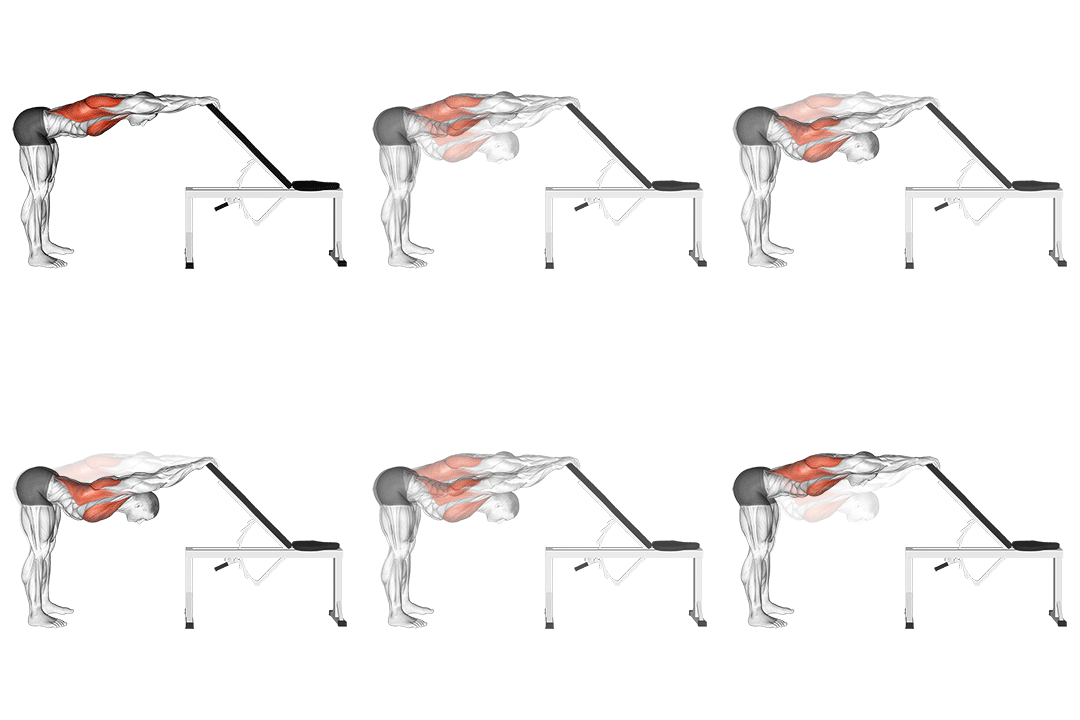
The back pec stretch is a deceptively named drill that despite the 'pec' label primarily targets the upper back — the rhomboids, mid-traps, and rear delts. Standing tall with arms extended in front, you cross the arms in front of the body, interlace the fingers, rotate the palms outward, and slowly raise the arms upward and away from the body. The combined motion produces a stretch through the upper back and rear shoulder area while the chest opens slightly as a secondary effect. This stretch addresses one of the most chronically tight areas in adults who do regular pulling work or have rounded-shoulder posture. The rear deltoids and middle back tighten quietly under the constant forward-leaning patterns of modern life, and dedicated stretching of these areas is rarely included in standard mobility routines. The back pec stretch fills that gap with a single drill that hits multiple connected tight spots. Where this earns its place is as a complement to traditional chest stretches in postural correction routines. Most people focused on rounded posture stretch the chest and ignore the back; those focused on back tightness stretch the back and ignore the chest. Both approaches miss half the equation. Combined with doorway pec stretches and rear deltoid cross-body stretches, the back pec stretch addresses the connected tightness patterns more completely than any single stretch alone. Daily practice over 4-6 weeks produces noticeable postural improvement and reduced upper-back tension.
Why train the Back Pec Stretch?
- Lengthens the rhomboids, mid-traps, and rear delts in one accessible stretch.
- Counters the chronic upper-back tightness common in adults who do pulling work.
- Improves shoulder blade mobility through the upper back lengthening.
- Pairs naturally with chest stretches for compound posture correction.
- Costs nothing, requires no equipment, and integrates easily into any routine.
- Suitable for all fitness levels including older adults and those returning from injury.
How to do the Back Pec Stretch: step by step
- 1Stand tall with your feet shoulder-width apart.
- 2Extend your arms straight out in front of you, parallel to the ground.
- 3Cross your arms in front of your body, with your right arm over your left arm.
- 4Interlock your fingers and rotate your palms away from your body.
- 5Slowly raise your arms up and away from your body, feeling a stretch in your back and chest.
- 6Hold the stretch for 15-30 seconds, then release.
- 7Repeat on the opposite side.
Muscles worked
Primary
lats
Secondary
shoulders, chest
Common mistakes to avoid
Hunching the upper back during the stretch
When the arms reach upward, the body wants to round the upper back. This actually shifts the stretch away from the target tissue. Keep the chest open and the upper back tall throughout.
Forcing the palms-out rotation
The palm rotation matters but shouldn't be forced. If shoulder mobility limits the rotation, modify with whatever rotation feels comfortable. The benefit comes from the overall position, not just the rotation detail.
Holding too short
Brief holds barely cue the upper back to release. Aim for 30-45 seconds, breathing slowly. The deeper release happens about halfway through.
Skipping side alternation
Crossing arms with right over left is not the same as left over right — the muscle emphasis shifts slightly. Always alternate the crossing arm position to balance the stretch.
Skipping when 'feeling fine'
Upper back tightness develops gradually. Daily practice prevents accumulation. Show up even when nothing feels obviously tight.
Easier and harder variations
Easier
Skip the palm rotation and finger interlace — just cross the arms in front and let them rest there. The simpler position still provides upper back stretch at lower intensity.
Harder
Add a slight forward lean while maintaining the arm position to deepen the upper back stretch. Or progress to kneeling lat stretches and cross-body shoulder stretches for more targeted upper back work.
Alternative exercises
Cross-body shoulder stretch
More targeted rear deltoid stretch. Pair with the back pec stretch for compound upper back mobility.
Doorway pec stretch
Targets the chest specifically, the opposing tightness pattern. Use with back pec stretch for complete posture correction.
Upper back stretch (overhead arms)
Different angle for upper back lengthening. Useful complement in mobility programming.
How to program the Back Pec Stretch into your training
The back pec stretch works as a daily mobility habit for trainees with rounded posture or upper back tightness. Daily routine: 1-2 sets of 30-45 seconds, alternating arm-crossing positions between sets. Once or twice per day. Desk-break protocol: 1 set of 30 seconds every 90-120 minutes during long sitting sessions. Post-workout protocol: 1-2 sets after pulling sessions to release accumulated tension. For those with rounded-shoulder posture: 4-5 mini-sessions per day at 30 seconds each, paired with chest stretches and rear shoulder strengthening. Combined approach over 4-6 weeks produces meaningful postural change. For general fitness: 2-3 times per week is sufficient maintenance. Don't program this in isolation — pair with chest stretches and rear shoulder strengthening for full postural correction.
Recovery and frequency
The back pec stretch has zero recovery cost. Daily practice is safe and ideal.
Frequently asked questions
How long should I hold this stretch?
30-45 seconds per set, alternating arm crossing positions. 1-2 sets per session.
How often should I do this?
Daily, multiple times per day on long desk-bound days.
Will this help my posture?
Partially. Combined with chest stretches and rear shoulder strengthening, daily practice produces meaningful postural change over 4-6 weeks.
Why do my shoulders feel tight?
Often because both the chest (front tight) and upper back (back tight) are involved. Address both sides for compound benefit.
Should I do this before or after workouts?
Both serve different goals. Before: brief stretches as warm-up. After: longer holds for tissue change.
Can I do this at my desk?
Yes — the stretch is desk-friendly and produces no obvious motion for office contexts.
Useful tools for this exercise
Build a workout with the Back Pec Stretch
Puna gives you guided bodyweight workouts you can do anywhere — no equipment, no gym, just structured progressions that build real strength.