Push-up To Side Plank
intermediate strength exercise · body weight · targets abs
- Body part
- waist
- Primary target
- abs
- Equipment
- body weight
- Difficulty
- intermediate
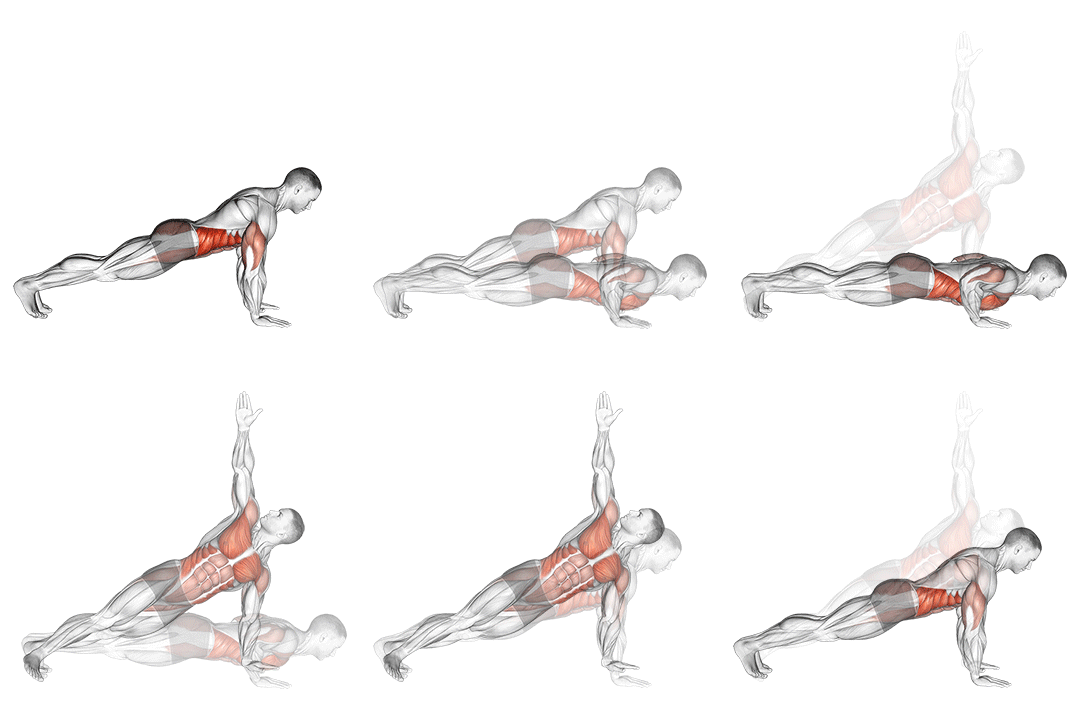
The push-up to side plank stitches together two foundational movements into a sequence that hammers the core through both motion and isometric hold. You press up from a push-up, then rotate the entire body into a side plank with one arm reaching overhead — repeat on the other side. The combination forces the obliques to fire under load (the rotation), the shoulder stabilizers to control body weight on a single hand (the side plank top), and the chest and triceps to drive the push-up itself. It's a coordination exercise as much as a strength one. The side plank rotation reveals which side of your trunk is weaker — most people find one side significantly easier than the other in the first few weeks of doing this movement. That asymmetry is information; it tells you where your unilateral core weakness lives, and over 6-12 weeks of practice you can close most of the gap. This works best as a warm-up superset or a finisher rather than a pure strength builder. The complexity makes it less effective for hypertrophy than a focused chest exercise, but the combined demand on the obliques, deltoids, and serratus makes it a high-leverage choice for athletes whose sport requires rotating against a load — combat sports, climbing, throwing sports, and most field sports.
Why train the Push-up To Side Plank?
- Trains the obliques in their actual function: rotating and stabilizing the trunk under load.
- Builds shoulder stability on a single arm, which protects you in pushing and overhead movements.
- Combines pressing and core work in one set, saving time in shorter sessions.
- Reveals weak links — the side you can't rotate cleanly into is the side that needs more single-side work.
- Translates well to combat sports, climbing, and any sport that requires rotating against a load.
- Improves serratus anterior activation, which protects the shoulder blade and helps overhead movements feel smoother.
How to do the Push-up To Side Plank: step by step
- 1Start in a push-up position with your hands shoulder-width apart and your body in a straight line.
- 2Lower your body towards the ground by bending your elbows, keeping your core engaged.
- 3Push back up to the starting position.
- 4Shift your weight onto your left hand and rotate your body to the right, lifting your right arm towards the ceiling.
- 5Hold the side plank position for a few seconds, then return to the starting position.
- 6Repeat the push-up and side plank on the opposite side.
- 7Continue alternating sides for the desired number of repetitions.
Muscles worked
Primary
abs
Secondary
shoulders, chest, triceps
Common mistakes to avoid
Collapsing the bottom hip into the floor at the top of the side plank
If your bottom hip drops, the obliques stop doing their job and the lower back takes the load. Drive the hip up so your body forms a straight diagonal line from heels to head.
Snapping the rotation instead of controlling it
Whipping into the side plank uses momentum and skips the actual core work. Rotate slowly enough that you could pause halfway up — that's the position the obliques are working in.
Spreading the feet too wide for stability
Stacking the feet on top of each other (or in tandem with one in front of the other) is the right form. Spreading them wide makes the side plank too easy and removes most of the core demand.
Ignoring the weaker side
When one side is harder, it's tempting to do extra reps on the strong side. Always do equal reps per side, and stop the set when the weak side fails — chasing extra reps on the strong side just widens the asymmetry.
Letting the supporting shoulder shrug toward the ear
At the top of the side plank, packed shoulders matter. Drive the supporting shoulder away from the ear by pushing the floor — this protects the rotator cuff and trains the serratus properly.
Easier and harder variations
Easier
Drop the push-up — just do alternating side planks from a high plank position, rotating without the press. Once that feels controlled for 8-10 per side, add the push-up back in.
Harder
Hold the side plank at the top for 3-5 seconds before rotating back. Or progress to a side plank with leg raise — lift the top leg as you rotate up for added glute and abductor work.
Alternative exercises
T push-up
Same movement pattern, often a synonym depending on the source. Use it as a name when looking up additional cueing or video demos.
Renegade row
Push-up plus alternating dumbbell row. Different upper body component but similar anti-rotation core demand.
Side plank with reach-through
From a stationary side plank, thread the top arm under the body and back. Builds the same oblique strength without the push-up demand.
How to program the Push-up To Side Plank into your training
Push-up to side plank works best as a secondary movement in a session, not the main lift. Use it after your primary press or pull, when the main strength work is already done and you want to add coordination and core demand. Sets and reps: 3 sets of 6-10 reps per side with 60-90 seconds rest. Total reps per session in the 30-60 range across both sides combined. Going beyond that usually means form decays and you stop training the obliques effectively. A good full-body session structure: heavy main lift (squat or deadlift variation) → push-up to side plank as accessory work → finisher of cardio or carries. The combination of strict push-up and rotation fits well in a workout flow without conflicting with heavier work. For sport-specific athletes, schedule it 2-3 times per week alongside other anti-rotation work like Pallof presses or bird dogs. The combination addresses both rotational strength and anti-rotational stability, which are different qualities. If you're using it as a finisher, run it as a tabata: 20 seconds of work, 10 seconds rest, for 8 rounds. This builds work capacity without the joint stress of a heavy strength piece.
Recovery and frequency
The combined demand on chest, shoulders, obliques, and serratus means push-up to side plank can leave you sore in unexpected places — particularly the side of the rib cage and the lateral shoulder. That's normal in the first 2-3 weeks of training the movement, and it fades as the obliques adapt. 48 hours between sessions is enough recovery for most people. The shoulders take the most cumulative load, so if you're also doing other pressing work in the same week, watch for anterior shoulder fatigue and back off frequency if the joint feels achy. Foam roll the lats and upper back once a week to maintain the thoracic mobility this movement assumes.
Frequently asked questions
How many sets and reps of push-up to side plank should I do?
3 sets of 6-10 reps per side with 60-90 seconds rest. Quality of rotation matters more than rep count — stop the set when you can't hit a clean side plank.
How often should I train the push-up to side plank?
2-3 times per week. The chest, shoulders, and core all need recovery between sessions, especially with the unilateral load on each side plank.
Should I count one rep as both sides or each side separately?
Each side separately. Counting one rotation per rep makes programming clearer and prevents you from cheating one side when fatigue hits.
Why is one side so much harder than the other?
Almost everyone has core asymmetry — usually the dominant-arm side feels easier because the trunk is used to stabilizing for that arm. The asymmetry typically narrows within 6-12 weeks of equal-rep practice.
Is push-up to side plank good for fat loss?
It's a good metabolic conditioning piece because it works many muscle groups simultaneously, but no single exercise drives fat loss. Total weekly training volume and nutrition do most of the work.
Can I do this exercise if my push-up form is still developing?
Better to nail the push-up first. Adding rotation on top of a shaky push-up reinforces bad pressing patterns. Build to 10 clean push-ups before introducing the side plank rotation.
Useful tools for this exercise
Build a workout with the Push-up To Side Plank
Puna gives you guided bodyweight workouts you can do anywhere — no equipment, no gym, just structured progressions that build real strength.