Power Point Plank
intermediate strength exercise · body weight · targets abs
- Body part
- waist
- Primary target
- abs
- Equipment
- body weight
- Difficulty
- intermediate
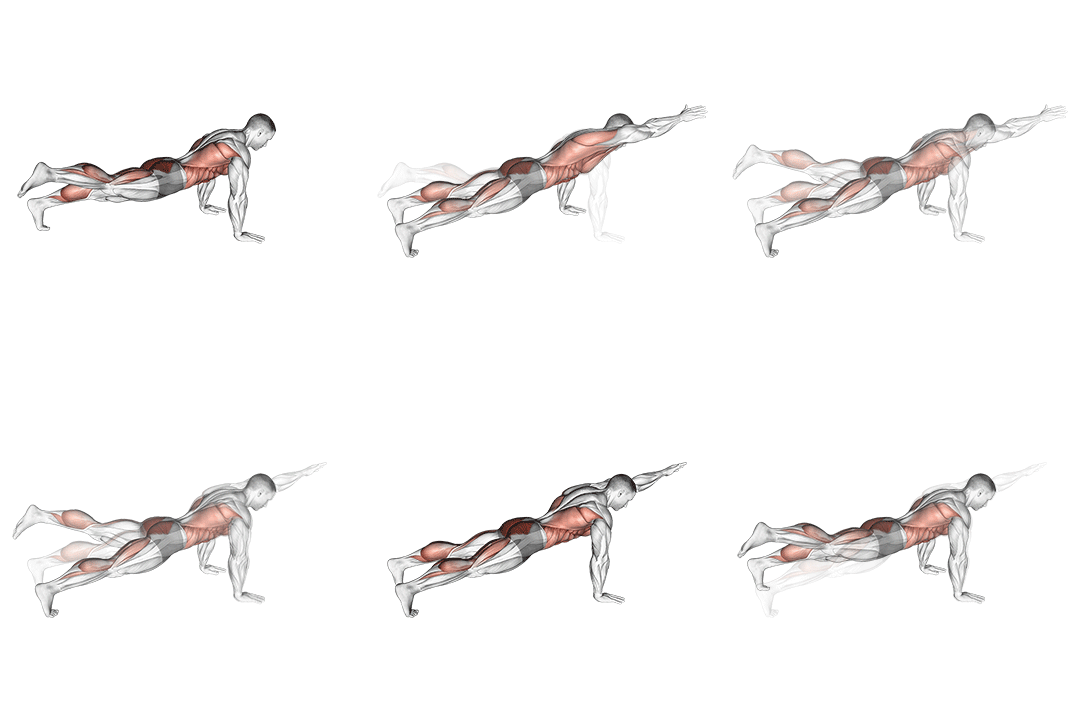
The power point plank is an advanced plank variation performed with one arm and the opposite leg lifted off the floor simultaneously, creating a starfish-like position supported on just two contralateral limbs. The dramatically reduced base of support forces the deep core to work much harder than in a standard plank, while the lifted arm and leg add anti-rotation demand as the body fights to stay parallel to the floor. It's the natural evolution of the standard plank for trainees who can hold 60+ seconds easily. Where the basic plank is primarily an isometric anti-extension exercise, the power point version adds anti-rotation, balance, and coordination — turning a static hold into a dynamic full-body stability challenge. The combined demand makes it useful well beyond what the standard plank trains. It's also a humbling exercise. Trainees who can hold a 2-minute basic plank often can't make 30 seconds of a clean power point plank in their first attempts. That gap reveals exactly what most plank training misses: the anti-rotation and unilateral stability components. Programmed once or twice a week alongside other core work, the power point plank closes that gap quickly.
Why train the Power Point Plank?
- Trains anti-rotation core strength alongside the anti-extension function of standard planks.
- Reveals unilateral and rotational asymmetries that bilateral planks hide.
- Builds shoulder and hip stability simultaneously — the supporting arm and leg both work hard.
- Useful progression for trainees who have outgrown standard planks.
- Carries over to athletic movements requiring trunk stability while limbs move independently.
- Requires no equipment and minimal space.
How to do the Power Point Plank: step by step
- 1Start in a high plank position with your hands directly under your shoulders and your body in a straight line from head to toe.
- 2Engage your core and squeeze your glutes to maintain a stable position.
- 3Lower your body down onto your forearms, one arm at a time, maintaining a straight line from head to toe.
- 4Hold this position for the desired amount of time, keeping your core and glutes engaged.
- 5To return to the starting position, push through your forearms and lift your body back up into a high plank position.
- 6Repeat for the desired number of repetitions.
Muscles worked
Primary
abs
Secondary
shoulders, triceps, glutes
Common mistakes to avoid
Letting the hips rotate as the limbs lift
When you lift the arm and opposite leg, the body wants to rotate so the chest faces the lifted-arm side. Keep both hip points facing the floor by bracing the abs hard before lifting and maintaining the position throughout.
Lifting the limbs too high
Trying to lift the arm and leg toward the ceiling forces the lower back to arch. Lift only as high as you can keep the body parallel to the floor — usually about hip-height for the leg and shoulder-height for the arm.
Holding for too long with poor form
A 60-second power point plank with rotation is worse training than 20 seconds of a clean one. Stop the hold the moment the hips rotate or sag — quality of position is what trains the core.
Bending the supporting elbow
The supporting arm should be straight and stacked under the shoulder. Bending the elbow shifts load away from the core and onto the supporting arm. Keep that arm locked throughout the hold.
Spreading the supporting foot too wide
The supporting foot should stay close to the body's centerline. Stepping it out wide makes the position too easy and removes the anti-rotation challenge.
Easier and harder variations
Easier
Lift only the arm, keeping both feet on the floor (or vice versa). Or lift the arm and leg from a standard high plank position with three points of contact (lift just one limb at a time, alternating).
Harder
Add a hold (10-20 seconds per side instead of just lifting briefly). Or alternate the arm-leg pairs in continuous motion (a few seconds per side, switching back and forth). Or progress to side planks with leg lifts for even more unilateral stability work.
Alternative exercises
Bird dog
Performed on hands and knees with the same contralateral arm-leg lift. Easier regression that trains the same anti-rotation pattern.
Side plank
Different position (lateral instead of front-facing) that loads the obliques heavily. Useful complement to the power point plank.
Front plank with hip dip
Standard plank with hip dips side to side. Trains rotation control without the unilateral support demand.
How to program the Power Point Plank into your training
Power point planks work as either the primary core exercise in a focused session or as accessory after main strength work. Sets and reps: 3 sets of 20-45 seconds per side with 30-60 seconds rest between sides. Total weekly volume of 4-8 minutes of holds drives most adaptations. In a complete core circuit: 3 rounds of 30-second power point plank per side, 10 dead bugs per side, 30-second side plank per side, 12 reverse crunches. Done 2-3 times per week. As a warm-up before strength training: 1-2 sets of 20 seconds per side. Activates the deep core before heavier lifting. For athletes building rotational stability, pair power point planks with Pallof presses or anti-rotation cable work in the same session. The combination addresses anti-rotation from multiple angles. Do not program power point planks for time when fatigue causes form decay. Stop the hold when the hips rotate or sag — chasing time at the cost of position trains the wrong pattern.
Recovery and frequency
Power point planks at moderate volume have low recovery cost — 48 hours between dedicated sessions is plenty. The shoulders take some cumulative load from the unilateral support; if shoulders feel achy after sessions, reduce volume or alternate with non-plank core work. Deep ab and oblique soreness in the first 1-2 weeks of training is normal. Lower back fatigue after the exercise usually means the hips were rotating during the holds — address form before continuing.
Frequently asked questions
How many sets and reps of power point planks should I do?
3 sets of 20-45 seconds per side with 30-60 seconds rest. Total weekly volume of 4-8 minutes of holds.
How often should I train the power point plank?
2-3 times per week as part of a structured core program. The shoulders and core need 48 hours of recovery between sessions.
Power point plank vs standard plank: which is better?
Different tools. Standard planks train pure anti-extension. Power point planks add anti-rotation and unilateral support demand. Use the standard plank as your foundation; add the power point version once you can hold standard planks for 60+ seconds easily.
Should I count one rep as both sides or each side separately?
Each side separately, both for reps and time. The two sides are different unilateral exercises (left arm + right leg vs right arm + left leg), and tracking them separately reveals asymmetries.
Why is one side so much harder than the other?
Almost everyone has unilateral stability asymmetry. The dominant-arm side usually feels easier because the body is more practiced at stabilizing for that arm. The asymmetry typically narrows within 6-12 weeks of equal-time practice.
Are power point planks safe with shoulder issues?
Depends on the issue. The supporting arm bears significant load. If you can hold a basic plank without shoulder pain, the power point version is usually fine for short holds. Skip if standard planks aggravate your shoulder.
Useful tools for this exercise
Build a workout with the Power Point Plank
Puna gives you guided bodyweight workouts you can do anywhere — no equipment, no gym, just structured progressions that build real strength.