Potty Squat
beginner strength exercise · body weight · targets abs
- Body part
- waist
- Primary target
- abs
- Equipment
- body weight
- Difficulty
- beginner
The potty squat — also called the deep squat, third-world squat, or Asian squat — drops the hips below knee level and holds the bottom position, mimicking how humans across most of the world rest, eat, and use the bathroom. It's classified here as a core/abs exercise because of the deep bracing required to stay upright at full depth, but its real value is mobility: hip flexion, ankle dorsiflexion, and thoracic extension all work together to let you hold this position comfortably. If you grew up sitting in chairs, the bottom of this squat will feel impossible at first — that's not a strength problem, it's a stiffness problem in the hips, ankles, and thoracic spine. Adding it to your day, even just 60 seconds of accumulated time, undoes a surprising amount of desk-sitting damage. Most people who can hold the bottom for 2 minutes report fewer lower back issues, easier deadlifting form, and improved running mechanics within 6-8 weeks. The deep squat isn't an exercise you "do reps of" — it's a position you accumulate time in. Treat it like a stretch you visit multiple times a day rather than something you crush in one session. The compound effect of brief, frequent exposure is what restores the range, not occasional long bouts.
Why train the Potty Squat?
- Restores deep hip flexion that disappears with chair-bound lifestyles, often within 4-8 weeks of daily practice.
- Improves ankle dorsiflexion, which carries over to running, jumping, and full-depth back squats.
- Decompresses the lower back when held for 30+ seconds at the bottom — many desk workers feel immediate relief.
- Trains your core to brace upright at end-range hip flexion, a pattern useful in deadlifts, gardening, and lifting children.
- Costs zero money and takes zero space — you can do it while brushing your teeth or waiting for coffee.
- Often reduces knee discomfort over time by restoring full joint range, contrary to the myth that 'deep squats hurt knees'.
How to do the Potty Squat: step by step
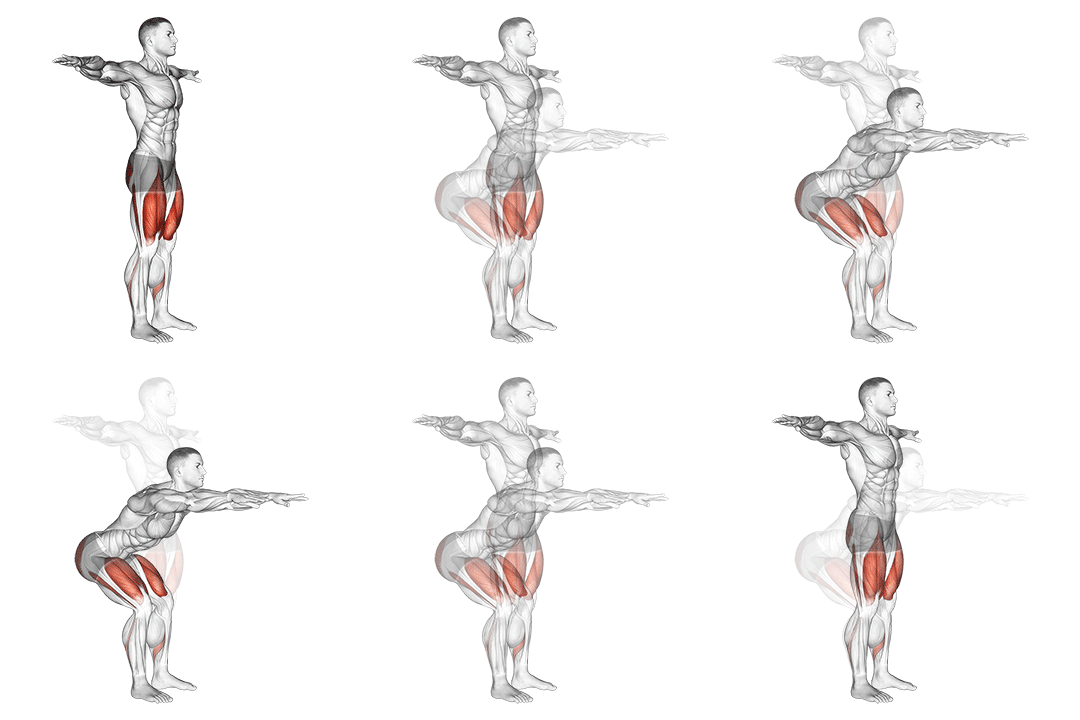
- 1Stand with your feet shoulder-width apart, toes pointing slightly outward.
- 2Lower your body down by bending your knees and pushing your hips back as if you were sitting on a chair.
- 3Keep your chest up and your back straight throughout the movement.
- 4Lower yourself until your thighs are parallel to the ground or as low as you can comfortably go.
- 5Pause for a moment at the bottom, then push through your heels to return to the starting position.
- 6Repeat for the desired number of repetitions.
Muscles worked
Primary
abs
Secondary
quadriceps, glutes
Common mistakes to avoid
Letting the heels lift off the ground
If your heels rise as you sink down, your ankle mobility is the limiting factor. Stack a 1/2-inch wedge or a folded towel under your heels until you build the ankle range to squat flat-footed.
Rounding the lower back at the bottom
A rounded back at depth means your hip mobility hasn't caught up to the depth you're trying to reach. Don't go as deep — squat only as low as you can hold a neutral spine, even if that's just halfway.
Treating it like a strength rep instead of a hold
Bouncing in and out of the bottom misses the point. Sink down, hold for 30-60 seconds, then stand. Time-under-tension is what unlocks the mobility.
Forcing the knees out artificially
Some cues encourage flaring the knees outward aggressively. In the deep squat the knees should track in line with the toes naturally — no forced abduction. Forcing the knees out can stress the medial knee structures.
Holding your breath
Tension at the bottom often makes people brace and stop breathing. Breathe slow and deep through the nose — relaxed breathing is what lets the tissues actually lengthen.
Easier and harder variations
Easier
Hold onto a doorframe or sturdy pole in front of you and use it for assistance going down and up. Reduce assistance as your mobility and balance improve over weeks, not days.
Harder
Add load: hold a kettlebell or dumbbell at chest height as a counterweight (counterintuitively, this often makes deep squats easier to balance). For pure difficulty, hold the bottom for 2+ minutes.
Alternative exercises
Goblet squat hold
Same deep position but with a kettlebell at the chest. The counterweight makes balance easier while the load builds strength at depth.
Cossack squat
Side-to-side deep squat that adds a hip adduction component. Excellent for building lateral hip mobility alongside flexion.
90/90 hip stretch
Floor-based hip mobility drill that addresses similar restrictions as the deep squat without requiring ankle range. Useful complement during the early weeks.
How to program the Potty Squat into your training
The potty squat is a daily mobility practice, not a workout. Best implementation: accumulate 2-5 minutes per day at the bottom, broken into 30-60 second chunks. Two minutes once a day works; four 30-second holds spread through the day works better. Anchor it to existing daily habits: hold for 60 seconds while waiting for the kettle, while brushing your teeth, while playing with kids on the floor. The goal is to make it part of how you live, not something you have to remember. For dedicated mobility sessions, work the deep squat at the start: 3 rounds of 60 seconds at the bottom, with 30 seconds of standing rest between. Follow with calf stretches and 90/90 hip stretches if the deep squat exposed restrictions there. Within a strength training session, use the deep squat as a warm-up before heavy squatting or deadlifting: 2 sets of 30 seconds before your main work. The improved hip and ankle mobility translates immediately to better squat depth and form. If you're chasing a specific goal — like sitting flat-footed for an extended period to read or work on your laptop — build to it gradually. Aim for 5 minutes total in week 1, 10 minutes in week 4, 20 minutes by week 8. The body adapts faster than people expect once exposure is regular.
Recovery and frequency
Mobility work compounds with frequency, so the deep squat is one of the few movements that truly is fine to do daily. There's no muscle damage to recover from in a passive hold, only tissue lengthening to consolidate. If you experience knee or hip discomfort the day after deep squatting for the first time, that's typically your joints adjusting to a range they haven't visited in years — it usually fades within a week of continued practice. Sharp or sustained pain is a different signal: back off depth and consult a physical therapist if it persists. Hydration and decent sleep both help connective tissue recovery, but no special protocol is needed beyond consistent daily exposure.
Frequently asked questions
How many sets and reps of the potty squat should I do?
Treat it as a hold, not a rep exercise. Accumulate 2-5 minutes per day at the bottom, broken into 30-60 second chunks. Daily exposure beats long single sessions.
How often should I train the potty squat?
Daily. Mobility work compounds with frequency — 2 minutes every day will give you better results than 14 minutes once a week.
Why can't I get my heels down in the deep squat?
Tight calves and stiff ankles are the usual culprits. Spend 1-2 minutes calf-stretching against a wall before each attempt, and use a heel wedge in the meantime so you can still practice the position.
Are deep squats bad for my knees?
Research consistently shows that deep squats — performed without weight or with appropriate weight — do not damage healthy knees. Most knee discomfort during deep squats comes from form errors or pre-existing restrictions, not the depth itself.
How long until I can hold the deep squat for 2 minutes?
Most adults reach 2-minute holds within 6-12 weeks of daily practice, starting from 30-60 second segments. Fastest progress comes from short, frequent exposures rather than long single sessions.
Is the deep squat the same as the third-world squat or Asian squat?
Yes — these are different cultural names for the same position. The 'third-world' name refers to its prevalence in regions where chair use is less universal; 'Asian squat' similarly describes its everyday use across much of Asia. The mechanics are identical.
Useful tools for this exercise
Build a workout with the Potty Squat
Puna gives you guided bodyweight workouts you can do anywhere — no equipment, no gym, just structured progressions that build real strength.