Modified Push Up To Lower Arms
intermediate strength exercise · body weight · targets forearms
- Body part
- lower arms
- Primary target
- forearms
- Equipment
- body weight
- Difficulty
- intermediate
The modified push-up to lower arms — sometimes called the forearm extender push-up — is one of the few bodyweight exercises that genuinely loads the forearms through their full working range. From a standard push-up position, you lower yourself onto your forearms, then push back up to the palms. Each rep is essentially a single push-up performed by the wrist extensors and triceps in series, which is why it builds the kind of forearm strength climbers, gymnasts, and grapplers actually use. It looks easier than a regular push-up — until you try it. The transition between palms and forearms loads the wrists in a way most people never train, and the small muscles of the forearm fatigue surprisingly fast. Expect to feel it primarily in the brachioradialis and the deep wrist extensors after just a few quality reps. For most trainees this sits in a useful niche: too specialized to be a main pressing movement, but too valuable to ignore if your goal is balanced upper-body health. Wrist tendinopathy is a common side effect of years of regular push-ups, and the modified push-up to lower arms trains exactly the tissues that prevent it. Programmed sparingly — 2 sessions per week of moderate volume — it's a strong addition to anyone serious about long-term joint resilience.
Why train the Modified Push Up To Lower Arms?
- Strengthens the forearms through a full pressing range, which most other bodyweight exercises don't reach.
- Bulletproofs the wrist by loading it under controlled, dynamic conditions rather than static holds.
- Trains the triceps with a slightly different pressing angle than a standard push-up, adding variety to upper-body training.
- Builds carryover to grappling, climbing, and gymnastic skills where forearm endurance is the limiting factor.
- Requires zero equipment, making it usable anywhere — at home, while traveling, or as a finisher in any session.
- Reinforces midline stability through the transition phase, training the core to resist sagging during direction changes.
How to do the Modified Push Up To Lower Arms: step by step
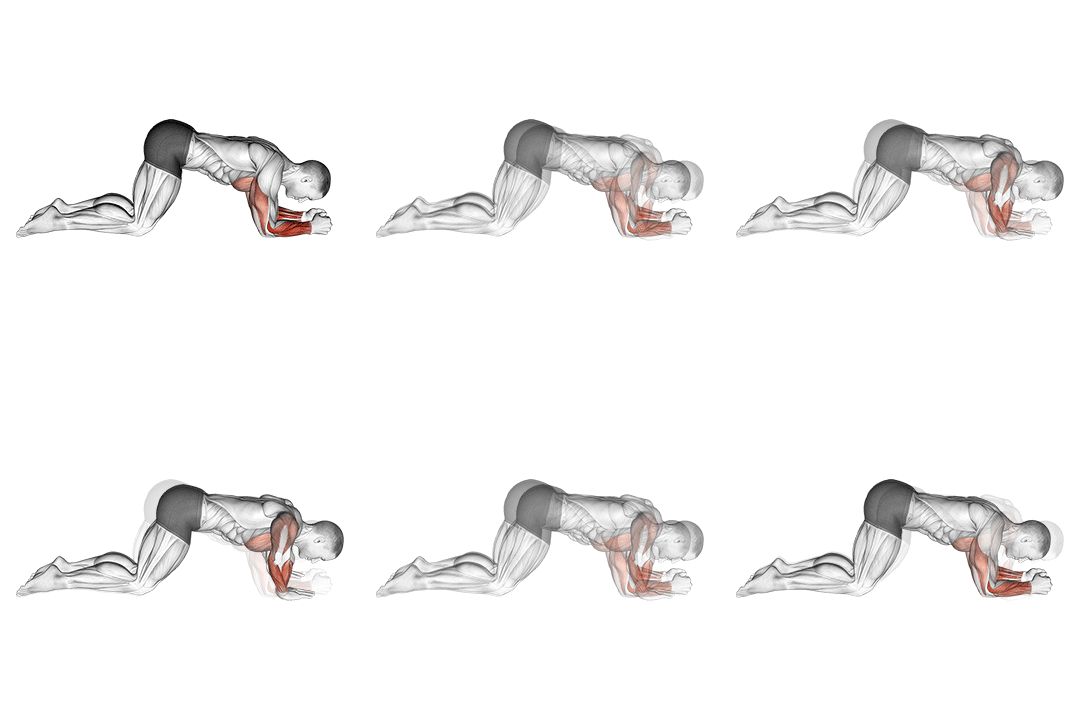
- 1Start in a push-up position with your hands directly under your shoulders and your body in a straight line.
- 2Lower your body down towards the ground by bending your elbows, keeping them close to your sides.
- 3Once your elbows are at a 90-degree angle, lower your forearms to the ground, keeping your elbows directly under your shoulders.
- 4Pause for a moment, then push through your palms to lift your forearms back up to the starting position.
- 5Repeat for the desired number of repetitions.
Muscles worked
Primary
forearms
Secondary
triceps, chest, shoulders
Common mistakes to avoid
Letting the hips sag during the transition
The moment you lower from palms to forearms is when most people lose the plank. Brace the abs and glutes throughout the movement; the body should travel as one unit, not break in the middle.
Slamming the forearms into the floor
Control the descent. Crashing onto the forearms loads the elbows and wrists with impact forces and trains a sloppy pattern. Lower one forearm at a time, deliberately.
Letting elbows flare wide
Elbows should track at roughly 30-45 degrees from the torso, not flared out to the sides. Wide elbows shift the load away from the triceps and strain the shoulder capsule, especially during the press-up phase.
Trying to do too many before the wrists are ready
The wrists adapt slower than the chest or triceps. Starting with sets of 10-15 will leave you with sore wrists for days and slow your overall training. Build up gradually from sets of 3-5 over several weeks.
Performing on a hard floor without padding
The forearms drop onto the floor every rep. On hardwood or concrete, this bruises the ulna and conditions you to flinch through reps. Use a yoga mat or a folded towel — it's not weakness, it's smart training.
Easier and harder variations
Easier
Drop to your knees instead of holding a full plank. This reduces the load on the forearms and the demand on the core, letting you focus on the transition pattern. Or perform with elbows on a couch or bench so the descent is shorter and the wrists handle less impact.
Harder
Slow the tempo to 3 seconds down and 3 seconds up — the time under tension exposes any weakness in the wrist extensors. Or progress to single-arm transitions, lowering one forearm at a time while the other holds a half push-up position.
Alternative exercises
Knuckle push-up
Loads the wrist in extension under static hold rather than through the transition. Complementary, not redundant — knuckle push-ups build wrist tolerance without the dynamic forearm component.
Farmer's carry
Trains forearm endurance through grip and isometric hold. Different mechanism (sustained tension vs. dynamic press), but addresses the same goal of forearm resilience.
Wrist push-up (planche-style)
Push-up performed on the back of the hand to load wrist flexion specifically. Pairs well with the modified push-up to lower arms for full-range wrist strength.
How to program the Modified Push Up To Lower Arms into your training
Treat the modified push-up to lower arms as accessory work for the forearms and wrists, not as a main pressing exercise. It belongs in the second half of an upper-body session, after you've handled your primary push and pull movements. Sets and reps: 3 sets of 5-8 reps with 60-90 seconds rest. Quality matters more than count — sloppy reps train no useful pattern and risk wrist strain. Progress to 4 sets of 8-10 once the movement feels controlled. Frequency: 2 sessions per week is plenty. The forearms are involved in every push, pull, and grip movement you do, so additional dedicated forearm work compounds quickly. Adding this to a standard upper-body day works well: 4 sets of 8 push-ups, 4 sets of 6 pull-ups, 3 sets of 6 modified push-ups to lower arms, 2 sets of 30-second hangs. For grapplers, climbers, or anyone with wrist issues from desk work: bump frequency to 3 sessions per week at lower volume (2-3 sets of 5 reps). The increased exposure builds tolerance faster than higher-volume sessions twice a week. Avoid programming this on consecutive days; the wrists need 48 hours minimum.
Recovery and frequency
The forearms recover fast for low volumes (3-5 sets per session) but get cranky at higher volumes. 48 hours between sessions is the minimum; 72 hours is wise in the first month. Wrist tendinopathy is the main risk to watch — sharp pain on the inner or outer wrist after a session is a signal to back off, not push through. If wrists feel tweaky, scale to knee variations or skip a session and resume at lower volume. Forearm soreness in the brachioradialis and wrist extensors is normal in the first 1-2 weeks and fades as the tissues adapt. Adding a daily 60-second wrist mobility flow (circles, prayer stretches, reverse prayer) accelerates the adaptation considerably.
Frequently asked questions
How many sets and reps of modified push-ups to lower arms should I do?
3 sets of 5-8 reps with 60-90 seconds rest, twice per week. Progress to 4 sets of 8-10 once the pattern is grooved. Higher volumes don't add much benefit and increase wrist strain risk.
How often should I train the modified push-up to lower arms?
2 times per week is the sweet spot. The forearms get hit in every other upper-body exercise, so dedicated work compounds fast. 3 sessions only if you're targeting wrist resilience for grappling or climbing.
Will this exercise hurt my wrists?
If you progress gradually, no — it actually strengthens the wrists. Soreness in the first 1-2 weeks is normal. Sharp pain or sustained discomfort means you're doing too much volume too soon; back off to 2-3 reps per set and rebuild.
How is this different from a standard push-up?
A standard push-up trains the chest, shoulders, and triceps with the wrists in a static hold. The modified push-up to lower arms adds dynamic loading to the forearms and wrist extensors through the palm-to-forearm transition. The pressing musculature still works, but the forearm demand is much higher.
Is this useful for sports?
Yes, especially for grappling, climbing, and any sport requiring forearm endurance. The forearms typically fatigue before the larger muscles in those contexts, and direct training closes the gap. For pure lifters or runners, the carryover is smaller — knuckle push-ups or hangs may suit them better.
Can I do this if I have a desk job?
Yes — and you probably should. Hours of typing creates chronic wrist flexion patterns that this exercise directly counters. Start with 2-3 reps per set and build slowly; desk-bound wrists are usually under-conditioned and need more time to adapt.
Useful tools for this exercise
Build a workout with the Modified Push Up To Lower Arms
Puna gives you guided bodyweight workouts you can do anywhere — no equipment, no gym, just structured progressions that build real strength.