Flag
advanced strength exercise · body weight · targets abs
- Body part
- waist
- Primary target
- abs
- Equipment
- body weight
- Difficulty
- advanced
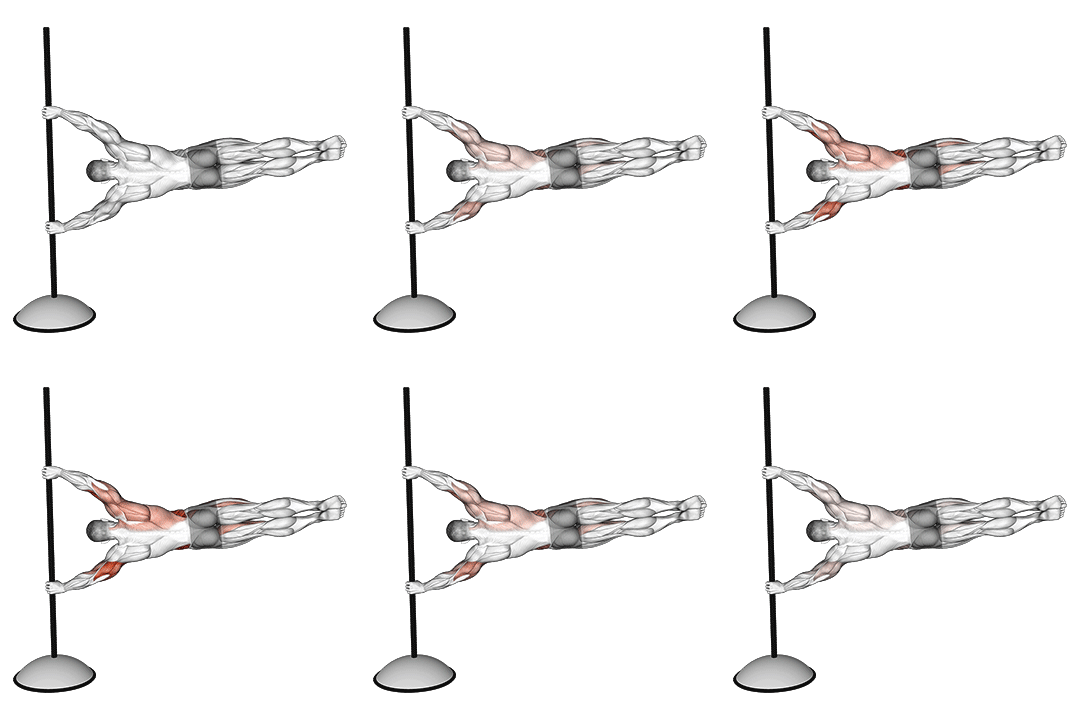
The flag — sometimes called the human flag or side flag — is an elite gymnastic skill where the body is held horizontal to the ground while gripping a vertical pole or bar with both hands stacked vertically. The body extends straight out to the side perpendicular to the pole, supported entirely by the shoulders, lats, obliques, and core. It's one of the most demanding bodyweight strength skills in existence and one of the most visually striking. The flag demands extreme integrated strength across multiple systems: shoulders to support the body weight, lats and obliques to hold the body horizontal, and core to maintain rigid alignment. Reaching even a brief 3-5 second flag hold typically requires 2-5 years of dedicated training. Few non-gymnasts ever achieve it. Where this earns its place is in elite calisthenics goals. The trade-off is the steep prerequisite demand and multi-year time commitment. For trainees pursuing the absolute pinnacle of bodyweight skills, the flag represents one of the ultimate achievements.
Why train the Flag?
- Builds elite integrated bodyweight strength across multiple systems.
- Develops extreme oblique and lateral chain strength.
- Provides ultimate static hold goal in calisthenics.
- Demonstrates exceptional grip, shoulder, and core integration.
- Carries over to advanced gymnastic skills.
- Visually striking achievement.
How to do the Flag: step by step
- 1Start by gripping a vertical pole with both hands, palms facing each other, and arms fully extended.
- 2Engage your core and lift your legs off the ground, keeping them straight.
- 3Using your core and upper body strength, raise your legs until they are parallel to the ground.
- 4Hold this position for as long as you can, maintaining a straight body line.
- 5Slowly lower your legs back down to the starting position.
- 6Repeat for the desired number of repetitions.
Muscles worked
Primary
abs
Secondary
obliques, shoulders
Common mistakes to avoid
Insufficient prerequisites
Build extreme oblique and grip strength through years of progressive training.
Skipping progression stages
Tucked flag → straddle flag → full flag. Each takes months.
Not addressing grip strength
The flag demands exceptional grip. Build through extensive hanging and gripping work.
Programming too aggressively
1 session per week. Recovery demands at this level are extreme.
Attempting on inappropriate equipment
Need vertical pole or sturdy vertical bar. Improper equipment is unsafe.
Easier and harder variations
Easier
Tucked flag (knees pulled to chest). Or band-assisted flag holds.
Harder
Add weighted vest. Or progress to dynamic flag work (entries and exits).
Alternative exercises
Side plank
Foundational lateral chain work.
Front lever
Similar elite static hold with different orientation.
Hanging oblique work
Builds the lateral strength for flag progressions.
How to program the Flag into your training
Flag training belongs in elite calisthenics programs. Prerequisites: Years of hanging and oblique strength work, healthy shoulders. Sets and reps: 3 sets of 3-10 second holds. Frequency: 1 time per week. For most trainees: this skill is unrealistic and unnecessary.
Recovery and frequency
Extreme recovery cost. 96 hours between sessions.
Frequently asked questions
How long to learn?
2-5 years from solid prerequisites.
How often?
1 time per week.
What equipment?
Vertical pole, sturdy vertical bar, or specialized flag pole.
Realistic for general fitness?
No — elite specialty skill.
Why so hard?
Demands extreme integrated strength across shoulders, lats, obliques, and core.
What's the easier version?
Tucked flag with knees pulled to chest. Significantly more accessible.
Useful tools for this exercise
Build a workout with the Flag
Puna gives you guided bodyweight workouts you can do anywhere — no equipment, no gym, just structured progressions that build real strength.