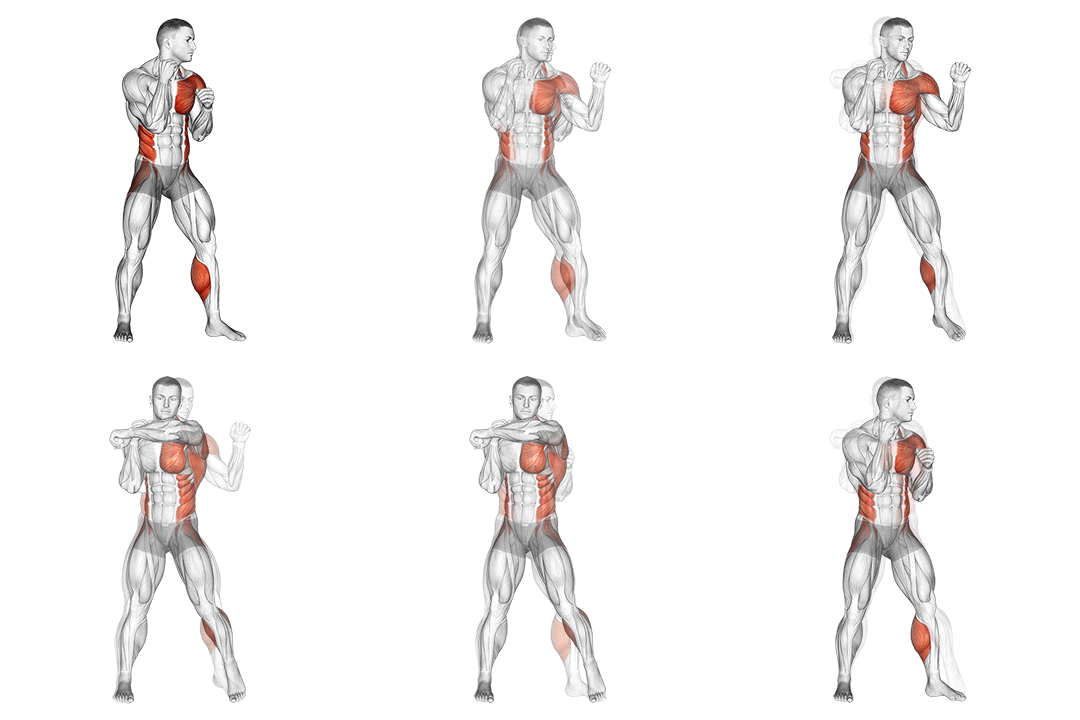
Left Hook (boxing)
intermediate strength exercise · body weight · targets delts
- Body part
- shoulders
- Primary target
- delts
- Equipment
- body weight
- Difficulty
- intermediate
The left hook is one of boxing's four core punches — and one of the most underrated bodyweight conditioning exercises for the shoulders, core, and rotational power chain. From a boxing stance, you pivot the lead foot, rotate the hips and torso, and drive a horizontal arc with the lead arm. The mechanics look simple but are deceptive: the power doesn't come from the arm, it comes from the ground reaction force traveling up through the legs, hips, and torso, with the arm acting as a transmission rod at the end of the chain. For non-boxers, the left hook earns its place as a strength and conditioning exercise primarily through its rotational training and shoulder endurance demands. Throwing 100 hooks in a session — even without weight — is a meaningful workout for the deltoids, the obliques, and the rotational hip muscles. It's also a useful drill for athletes in any sport that requires twisting power: golf, baseball, tennis, MMA. The pattern carries over to every sport where you need to deliver force horizontally through a rotating body. There are two ways to use the left hook in training. As a striker, the focus is technical: pivot mechanics, hip rotation, weight transfer, structural integrity. As a fitness exercise, the focus is volume: sustained throwing for cardio and conditioning, or paired with squats and burpees for full-body circuits. Both approaches teach the body to move power through the hips into the arm — a skill that pays off across athletic contexts and one most strength-only trainees never develop.
Why train the Left Hook (boxing)?
- Trains rotational power transfer from ground through hips into the arm — a missing piece in most strength programs.
- Conditions the deltoids and rotator cuff under high-volume horizontal load without weights.
- Builds oblique strength and core rotation control through hundreds of repeated twists.
- Spikes heart rate quickly when thrown in volume, contributing to cardiovascular conditioning.
- Improves coordination of the kinetic chain — the foot-hip-torso-arm sequence translates to most rotational sports.
- Burns notable calories: shadow boxing with proper technique consumes 8-12 calories per minute for an average adult.
How to do the Left Hook (boxing): step by step
- 1Stand with your feet shoulder-width apart and your knees slightly bent.
- 2Keep your left hand up to protect your face and your right hand by your chin.
- 3Rotate your hips and pivot on your left foot as you extend your left arm forward in a punching motion.
- 4Twist your torso and engage your core muscles to generate power in the punch.
- 5Snap your arm back to the starting position and repeat for the desired number of repetitions.
Muscles worked
Primary
delts
Secondary
biceps, triceps, forearms
Common mistakes to avoid
Throwing the punch from the arm instead of the hips
The most common beginner mistake. If the arm leads, the punch is weak, fatigues fast, and stresses the shoulder joint. Power initiates at the foot — pivot the lead foot, rotate the hips, and let the arm be the last thing to move.
Not pivoting on the lead foot
A planted lead foot blocks hip rotation and forces the punch to come purely from the upper body. The lead foot must pivot 30-45 degrees as the hips rotate. Practice in front of a mirror — you should see the heel come off the ground at the moment of impact.
Dropping the rear hand during the punch
When you throw the left hook, the right hand must stay up at the chin to protect the face. Many beginners drop the rear hand for balance, which in sparring leads directly to a counter-punch. Even in shadow boxing, ingrain the habit of keeping the guard up.
Hyperextending the elbow
The arm should never lock out at full extension during a hook. The elbow stays bent at roughly 90 degrees throughout the punch. Snapping the elbow straight risks hyperextension injury and produces a weaker, slower punch. Visualize the fist arcing horizontally, not pushing forward.
Holding the breath during the punch
Boxing power requires synchronized breath. Exhale sharply on the punch — a short hiss or 'tss' sound — and inhale on the reset. Holding the breath spikes blood pressure, slows the punch, and shortens how long you can sustain effort.
Easier and harder variations
Easier
Slow the tempo dramatically — 3-second punches with a clear pause between each. This lets you focus on the pivot, hip rotation, and arm path without the cardio fatigue of fast volume. Or practice with a single arm, alternating sides, to learn the mechanics one side at a time.
Harder
Add light dumbbells (1-3 lbs) for resistance. The added load builds shoulder endurance and rotational strength. Or progress to high-volume rounds: 3 minutes of continuous hook combinations with 1 minute of rest, repeated 3-5 times. This is genuinely demanding cardio. Eventually, train with a heavy bag for actual impact feedback and resistance.
Alternative exercises
Right cross
The straight rear-hand punch — uses similar rotational power but along a horizontal forward line rather than an arc. Pair with the left hook for a complete striking foundation.
Russian twist
Pure rotational core work without the arm component. Builds the oblique strength that powers hooks. Useful as accessory work for anyone training the punch.
Medicine ball rotational throw
Trains the same rotational power transfer with a load to release. Excellent strength complement to the high-volume conditioning that boxing provides.
How to program the Left Hook (boxing) into your training
Programming the left hook depends on the goal. For boxing skill: technical drilling at moderate volume, focused on form. For conditioning: high-volume rounds with heart rate elevated. For pure strength: paired with weighted resistance. Technical drilling: 5-10 minutes of slow shadow boxing, focusing on pivot and hip rotation. Throw 50-100 hooks at deliberate pace, watching form in a mirror. Done 2-3 times per week, this builds the motor pattern fast. Conditioning rounds: 3-minute rounds with 1 minute of rest between, mixing hooks with crosses and jabs. 3-5 rounds total. Heart rate stays above 150-170 bpm for most adults, making this serious cardio. 2-3 sessions per week is plenty. Volume training for shoulder endurance: 5 sets of 30 hooks per side with 60 seconds rest. Total of 300 hooks builds remarkable shoulder endurance over a few months. Add light dumbbells to scale up. Paired with bodyweight circuits: 30 seconds of hooks, 10 push-ups, 10 squats, 30 seconds of rest. Repeat 8-10 times for a 25-30 minute full-body circuit that demands cardio, strength, and coordination simultaneously. For non-boxers using the hook for fitness: 2 sessions per week is plenty. The shoulders take a beating from high-volume throwing, and rotator cuff irritation is common in week 2-3 of dedicated practice. Build volume slowly and pair with rotator cuff prehab work (band pull-aparts, external rotations).
Recovery and frequency
High-volume hook throwing taxes the deltoids, rotator cuff, and obliques. 48 hours between sessions is the minimum; 72 hours is wiser in the first weeks of training. The main warning signs are anterior shoulder pain (front of the deltoid), pain or popping deep in the shoulder during throws, and oblique strain pulling on the lower ribs. Rotator cuff irritation in particular is common when starting boxing-style training; if it appears, scale volume back to 30-50 hooks per session and add rotator cuff prehab. Daily rotational range of motion work and chest mobility help maintain the soft tissue around the shoulder. Hydration matters for sustained-effort training; protein intake supports the shoulder muscles' recovery from high volumes.
Frequently asked questions
How many left hooks should I throw in a session?
Depends on goal. Skill work: 50-100 deliberate hooks. Conditioning: 200-400 hooks distributed across 3-5 timed rounds. High-volume endurance: 5 sets of 30 per side. Build volume gradually — sudden jumps to high volume cause shoulder issues.
How often should I train the left hook?
2-3 times per week is plenty for non-boxers. Boxers training competitively go higher — 4-5 sessions per week with technical and conditioning days separated. The shoulder needs 48-72 hours between high-volume sessions to avoid rotator cuff issues.
Can I do this without a punching bag?
Absolutely — shadow boxing with no equipment is how most fighters drill technique anyway. The visual feedback from a mirror is more important than the impact feedback of a bag for the first few months. Add the bag when basic mechanics feel automatic.
Will throwing hooks hurt my shoulder?
It can if you build volume too fast or have weak rotator cuff musculature. Most shoulder issues come from doing too much too soon, not from the punch itself. Start with low volume (50-100 hooks per session), build slowly, and add rotator cuff prehab work.
How does this compare to working a heavy bag?
Different stimulus. Shadow hooks let you focus on technique without the impact load. Heavy bag adds resistance and impact feedback that shadow work can't replicate. Use both — shadow for skill, bag for power and resistance.
Will hooks help my golf or tennis swing?
Yes, indirectly. The rotational pattern (foot pivot, hip rotation, torso transfer, arm release) is the same kinetic chain that powers most rotational sports. Adding boxing volume to a sport-training program improves the underlying coordination, even though the surface skill differs.
Useful tools for this exercise
Build a workout with the Left Hook (boxing)
Puna gives you guided bodyweight workouts you can do anywhere — no equipment, no gym, just structured progressions that build real strength.